Putting my many cookbooks to good use by preparing one new recipe a week.
How It All Started
Bob Phillips
The title of this blog was inspired by one of my Spanish professor's at Miami University of Ohio, Dr. Robert Phillips, who died in the e...
Tuesday, September 4, 2012
Parm Perfection
Over the weekend, we enjoyed a terrific end-of-summer party with friends who shared all kinds of local bounty. Our contribution included our raspberry whitbeer and the first bottle of our Barolo -- which turned out very well indeed, and is expected to get even better -- any my second batch of weapons-grade ratatouille of the year.
Because our daughter became very fond of eggplant Parmesan, my attention the next day turned to that vegetarian mainstay. I have seen her enjoy it at quite a few restaurants and though my previous attempts have been less than stellar, I decided to try again, with particular attention to texture. As regular readers of this blog will not be surprised to learn, I turned once again to kitchen goddess Deborah Madison, only slightly modifying her recipe on page 279 of Vegetarian Cooking for All.
I do not want to give the impression that cheese is always the route to bliss in Madison's pages, but it did once again contribute to the success of this dish.
I started with one large eggplant from Hanson Farm -- about as local as possible. It was fresher than anything from the grocery store would be, but it did take me a couple of days to get to this recipe. So where Madison writes that the slices (1/3-inch) should be salted for 30 to 60 minutes unless the eggplant is farm fresh, I decided to compromise. I very lightly salted the slices on both sides and left them out for 15 minutes while packing up the car for said daughter's return to school (this was to be a farewell dinner).
I then blotted them, remembering an overly salty try at this recipe last year, and brushed both sides with olive oil. I placed them under the broiler, first a bit close, then a bit far, then back close, until both sides were browned, almost charred. It is the nature of eggplant that they never got crisp (as they might if I had let the salting go longer), but I got them to a nice, caramelized state.
Meanwhile, I had mixed a small can of tomato paste with a 15-ounce can of tomato sauce, in lieu of the fresh tomato sauce that Madison calls for. As this heated, I stirred in slivers of basil cut directly from our garden. I then brushed a very small amount of oil into a baking pan, spooned in some of the sauce, and layered the semi-charred eggplant -- I had just one layer, but more would have been great. Over this I sprinkled shredded mozzarella (Madison recommends slices of fresh mozz if available) and spooned over the remaining sauce.
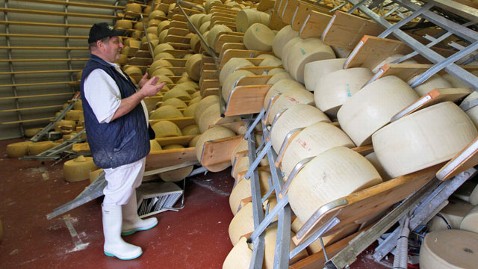
And then, of course, I sprinkled some cheese from our friends in Parma, grateful that the earthquake earlier this year did not get it all! I then baked for 25 minutes at 475 (convection), so that the sauce itself became sweet and sticky, along with the cheese. I had managed not to exceed the recipe's cheese parameters -- as I am often tempted to do -- but the meltiness made this dish just perfect for our daughter's sendoff.
Tuesday, October 18, 2011
You Had Me at Gratin
Our latest foray began in an interesting way. We had accumulated a few squash and fresh herbs over the past couple weeks, and were looking for an original way to use them. Pam turned to the index of VCE and found something that used the stuff we had -- or reasonable substitutions, such as butternut and pattypan (flying saucer) squash for the zucchini squash specified.
I must say that I consented to the choice Sunday night without looking at it, and in fact on Monday morning I realized that I had failed even to note the name or page number -- Summer Squash, Herb and Rice Gratin on page 286. Fortunately, Pam marked the recipe itself and noted the link back to the Béchamel sauce required. Unfortunately, the combination was not going to fit well between the evening's scheduled meetings.
In the end, all was well, as I was able to substitute ingredients and cut corners enough to make the dish fit in our time and ingredient constraints. The shredding of butternut squash is more time-consuming than zucchini, especially since we insist on shredding with our high-karma manual shredder, rather than any kind of electric gizmo. I did the shredding as quickly as I could, in order to give the lightly salted squash a bit of time to drain while I worked on the sauce and cooked the rice.
Béchamel sauce is sometimes described simply as "white sauce," but in the case of this recipe the scalded milk is first infused with onions and other herbs. We took a walk on the wild side -- as we so often do -- and just threw in all the herbs we had on hand. The infusion is done simply by scalding the milk with these ingredients and letting the chopped onion and herbs sit in the hot milk. Given the need to hurry, I kept the milk over a very low flame (cooking with gas!) and let it steep for just 5-7 minutes or so.
Here is the tricky bit, which I somehow actually did as instructed: Once I was satisfied that the milk was adequately aromatic, I poured it through a sieve into the bubbling butter-and-flour roux. As I write this, I realize that I could have sieved the milk and then whisked it into the roux, but that's not what Deborah Madison told me to do!
The basic idea of this recipe is to divide this herbish/onionish white sauce into two parts, mixing one part with rice and shredded squash for the bottom of the pan and mixing the other part with shredded Parmesan (see trusty shredder above; it got a work out) as a cheesy top layer. Then the whole thing gets browned in the oven.
"Gratin" means cheese, at least to me, which is why I dove into this recipe, despite my better judgment. The result was good enough that we will try this again, when we have a bit of leisure to do it right. We will refrain from mint, which was interesting but probably not ideal with the other herbs.
Sunday, May 15, 2016
Whaling House Waffle Surprise
This morning we had blueberries on hand, which I was going to add in the usual way -- about a cup to the batter just after it was combined. But Pam -- who already gets credit for remembering this post about corn meal -- suggested that I mash some of the blueberries, as she had recently done for Jordan Marsh muffins. So in addition to the cup of whole blueberries, I used a fork to mash about 1/4 cup, and put it in the liquid mix before combining. I just whisked the skins and pulp together into the egg-milk mixture. Saturday, February 8, 2014
Applish Waffles
![]() |
| Gary Trudeau alienated his friend Bill Clinton when he chose the waffle as the president's icon in Doonesbury. |
Eventually, we took a chance on a Belgian-style waffle iron at a church rummage sale, and found that it worked well for us, at least long enough for us to get hooked on the concept again. We eventually purchased a new Waring Pro, which has worked out very well for us. The recipe that came with the iron was a strange, two-part riddle like something out of the Common Core, so I turned to Madison, whose batter is quite simple:
3 eggs, beaten
1-1/2 cups milk or buttermilk
1/4 cup canola oil or melted butter
1 teaspoon vanilla extract (we use pure vanilla at Casa Hayes-Boh)
2 cups flour
1 teaspoon baking powder
1/2 teaspoon baking soda
1/4 teaspoon salt
I sifted the dry ingredients together into a bowl. (Up until recently I would have whisked them, but our baking-expert friend Betty recently convinced us of the value of a sifter. We purchase gadgetry for our kitchen only after months or years of deliberation!)
For the wet ingredients, I took a somewhat different approach. If buttermilk is an option for a batter, I rarely buy that ingredient, but nor do I like to use ordinary, flat milk. To get the right texture, I will sometimes add a bit of lemon or lime juice to milk, giving it a few minutes to curdle slightly. More often, I mix plain yogurt with plain milk. In fact, this is why we usually keep plain yogurt on hand (in addition to its use as a healthy alternative to sour cream as a taco topping). But I had neglected to pick any up lately, so I took a walk on the wild side: I put a cup of apple-flavored Greek yogurt in a measuring cup, and added plain milk to bring it to 1-1/2 cups.
I then used Pam (no relation) to prepare the iron, and made two waffles. The second smart thing I did was to wait until our darling teen was awake to offer her a waffle, rather than trying to wake her on a Saturday for the purpose. Win-win-win!
Monday, October 17, 2011
Watermelon-Lime-Mint-Feta salad
Thursday, July 19, 2012
We Got the Beet
The Go Go's always had the beet! The Rockefeller Center version confirms that these young ladies are part of our generation.
Readers of this blog might already know that beets are among our biggest local-food challenges. We try to eat all of our vegetables, but the icky texture and the aggressive blandness seem to dominate anything we prepare with beets. Once again, kitchen goddess Deborah Madison came to our rescue, with a green salad based on her "Grated Beet Salad with Cumin" (itself a variation of another salad on page 155 of Vegetarian Cooking for All).
I started by preparing the lime-cumin vinaigrette (p 185), a complex and savory sauce whose flavor could not be beeten. I began by mashing one garlic clove (from our Cochester Neighborhood Farm share) with 1/8t salt in our small mortar. Then I combined this with the zest of two limes and the juice of one lime (reserving a little straight lime juice for the chef!), 2T chopped scallions (also farm box) and half a chopped jalapeño. Then I toasted 1t cumin seeds in a dry cast-iron skillet (Madison calls for 1/2t each of cumin and coriander, but I could not find the latter). I cleaned out the mortar in order to crush the toasted seeds, and mixed them in, then whisked in 1/4t dry mustard and 1/3 cup olive oil (completely forgetting that I could have used jalapeño oil from L.O.V.E. --- more on that in a future post).
Now for the star of this salad, which we improved by demoting it to a supporting role. The recipe calls for one pound of beets -- I knew we did not have that much, but I used all we had, which was four or five small beets. I peeled and shredded them (again, see last year's gratin post for shredder details) and blanched them in boiling salt water (that is, I put them in only for a minute). I then drained, blotted, and sieved them so that I would not have a wet mess. At this point, we realized that -- for the first time in our lives -- we did not have enough beets! We were actually sharing this salad with friends, so Pam had the brilliant idea of combining it with cucumbers and greens -- also from this week's farm share -- before applying the lime-cumin concoction.
The result was actually delicious -- the greens solved the texture problem and the vinaigrette provided more flavor than even beets could absorb.
Friday, December 4, 2020
Ricotta Pancakes
When I saw this on a friend's page recently, I was intrigued:
I have been honing my approach to Deborah Madison's pancake recipe for close to two decades and had dedicated a page on my faculty web site to it before we began this blog.
Ina Garten's recipe is at first notable for the very forward use of lemon and fig, but her approach is also different in the fundamentals: half of the liquid portion is ricotta and a fifth of the dry portion is corn starch. I was intrigued and decided to give this a try, in part because we had some ricotta on hand.
The video itself does not provide enough detail to make this recipe work; when I tried to follow links associated with it, I was invited to download an app. Since I do not cook from my phone, I was at a bit of a loss, until the same friend who posted the video sent me the link to the full recipe -- from the app.
In fact, we had most of the ingredients except the figs and lemon on hand, but we had lemon juice. We also did not have buttermilk, but Deborah Madison teaches us that milk with a splash of lemon juice is a good substitute, after being allowed to rest for 10 minutes. Since I never drink buttermilk, I almost never buy it, always using this trick. In this case, I just used more than the usual lemon juice.
In place of figs, I chopped up a couple of small apples we had on hand, scattering them on top of the pancakes as in the video, rather than mixing them in the batter as I usually do. Incidentally, I usually do not peel apples before cooking with them -- it is easier to leave the skin on, and gives them an agreeable texture.
The batter had a distinctive texture -- almost spongy -- and the pancakes were as fluffy as they were delicious. I am glad that I did take time in the afternoon to buy some maple syrup at our local neighborhood farmstand. We had put it off for quite a while, and it was great to have the good stuff for these delicious, breakfast-for-dinner pancakes!
I rarely find figs in the wild (or supermarket), though I did take care of a fig tree for a rich family in Baltimore during my landscaping days. When I next encounter them (hint to local friends who might know a source), I will revisit this recipe.
![]() |
| Image (complete with figs): Food Network |
Tuesday, February 12, 2013
Blizzard warning
Monday, September 5, 2016
Favorite Biscuit Variation
It seems that we've mentioned Deborah Madison's Buttermilk Biscuits on several posts, but have been remiss in providing the recipe. This is likely because we've been enjoying these for so long they are hardly "new" to us. However, this week we did a few variations on the recipe, making it new again.
The recipe, as described in Deborah Madison's Vegetarian Cooking for Everyone, calls for
2 cups of flour
2 teaspoons baking powder
1/2 teaspoon baking soda
1/2 teaspoon of salt
1 cup of buttermilk
First, I will point out that we almost never use buttermilk, but substitute plain yogurt instead. Earlier this week when preparing to make these I realized we had only regular milk (no buttermilk, no yogurt). We learned a trick once of making a buttermilk substitute in 10 minutes by adding some vinegar to plain milk. Alas, we had no vinegar either. (Our larder was indeed spare as we had diligently eaten virtually everything in both our houses before taking an eight-day road trip to drop our daughter at college in the mid-west).
However, I was not about to let the lack of necessary ingredients stop me from having my biscuits. I used a substitute for the substitute -a meta-substitute- lemon juice did the same job of curdling the milk as vinegar. I also whisked in a dollop of sour cream. My next problem was that we were quite low on flour, and I discovered we were short by about 1/3 cup. I considered making a smaller batch of biscuits, but then I remembered that James improved on our waffle recipe earlier this year by putting in some corn meal in place of flour (see the entry here) and so I decided to try the same with the biscuits. I sifted the flour and corn meal in with the rest of the dry ingredients, then cut the butter into it with a pastry cutter. The sour milk/cream mix was added to the dry ingredients and mixed. James took over from there.
James:
I believe this is the second time we have used the Big Green Egg for biscuits. Thanks to the innovations Pam describes above, these were delicious! But thanks to my still-limited skills with the kamado-style grill, they were not beautiful. They look lovely in this photograph, taken a few minutes before they were done --
-- but they did not look quite so lovely as I scraped them from the baking stone. I had heated the grill to 500F, but had put the stone in for only a few minutes when I added the dough. I should have let it heat more thoroughly. The result was rather hot knuckles and a fair bit of batter left on the stone. By the time it cooled thoroughly, those remnants were quite charred, and the stone is soaking for a couple days as I write this.
The good news, though, is that the delicious biscuit tops had all the advantages of muffin tops.
Thursday, October 26, 2017
Candied Sweet Potatoes
I made this side dish from Deborah Madison so long ago I can't even remember what our main dish was, but I do know it was not a nueva receta. I think we must have gotten the sweet potato from the last Fairhaven Farmer's Market of the 2017 season. I do remember adding some "pumpkin spice" to this recipe by sprinking on some cinnamon and ground cloves. Madison never lets us down.
Tuesday, September 18, 2018
Applesauce!
We had some as a side dish for the tuna steaks with mushroom sauce James made for dinner, and also used it as a topping on our waffles the next morning.
The last bit of sauce was added as an ingredient to a big skillet cake that we shared for breakfast on Monday.
Saturday, October 6, 2012
Leek & Potato Soup
Milk is optional in this recipe, so it can easily be made vegan.
Monday, May 23, 2011
Sautéed Jerusalem Artichokes with Sunflower Seeds
Monday, September 4, 2017
Cobbler's Helper
If not quite mint-in-box, certainly excellent-in-box. We were excited to have it, but also completely clueless about its use. Fortunately, we both have 2017 information literacy, which suggests only one solution: YouTube. Searching on the brand name (because there are many contraptions of this sort out there), we quickly found all the information we needed in just three minutes:
I (Pam) of course couldn't wait to use my new (to me) gadget, so on Sunday at the Fairhaven Farmer's Market we bought a half dozen apples and got out our trusty Deborah Madison Cookbook (this is so essential we now keep copies both at home and in our beach house). I found a recipe for a simple cobbler, put the sliced apples in a pie tin, topped them with the dough, and baked at 350 for about half an hour for a lovely dessert.
![]() |
| The set up |
![]() |
| First apple placed |
![]() |
| The spinning starts... |
![]() |
| The cores went into the compost bucket |
![]() |
| Before baking |
![]() |
| Ready to eat! Delicious! |
Thursday, November 3, 2016
Cream of Tomato Soup
Monday, April 9, 2012
Pasta with asparagus, lemon, and herbs
To completely complicate things, I also prepared fettuccini alfredo while I was making this. My daughter was unwilling to try this one.
Monday, March 27, 2017
Irish Soda Bread
However, so as not to forgo an opportunity to prepare a new recipe I decided to make some Irish Soda bread to go with it. I found a good recipe in my trusty Deborah Madison vegetarian cookbook. The recipe is above. I made two changes to the ingredients as listed. I used wheat germ in place of wheat bran, and I added raisins. The bread was just a bit sweet and made a nice complement to the pasta, and made us feel like we celebrated St. Patrick's Day as we should have.
Saturday, August 9, 2014
Pancake Bush
For breakfast this morning, I offered to make pancakes, using the batter leftover from the efforts of our young chefs the day before as a starting point. There was not enough for the whole family and guest, so I augmented it with the ingredients from my own version of the recipe. This time I used 1/2 cup whole-wheat flour and 1 cup all-purpose, as I sometimes do. I used a spatula to alternate dry and wet ingredients (yogurt, vanilla, milk) and beat in one egg and a little canola oil.
Then came the fun part. Last year I had planted a blackberry bush, and in recent weeks had noticed it already starting to bear fruit. I had nibbled a few directly from the bush, and decided it was time to cook with them. We also had a few blueberries on hand and some butterscotch chips. Rather than mixing in any of these ingredients, I simply scattered them onto individual pancakes, so that we ended up with three different choices, all of which proved to be quite popular, especially when served with warmed, genuine maple syrup.
![]() |
| The blackberries were so big that I had to press them down a bit into the cooking pancakes. |
Wednesday, February 20, 2019
My First Turnovers
Friday, May 21, 2021
Quiche La Poodle
Notice: No actual poodles were involved in this dinner. Rather ...
As regular readers of Nueva Receta will have realized, we often let the National Day Calendar inspire our culinary choices. The pandemic has affected this tendency in two somewhat contradictory ways. We are more likely to have spare time to browse the site, but we are also less likely to dash out to grab ingredients for a last-minute recognition of a made-up holiday. (Additional notice: all holidays are made up, but that is a discussion for, well, another day.)
Fortunately, Pam noticed National Quiche Lorraine Day before I set out for our weekly grocery run, so I I managed to get all the bacon and chives needed to do complete the main version found on the Simply Recipes Quiche Loriaine page. Writer Elise Bauer suggests several options for the crust (including a crust-free variation), so we of course turned to Deborah Madison's tome for a basic recipe.
The "we" in the previous sentence is a bit different this time -- our wonderful kid Harvey is here for a long visit. Since he watches British baking shows a lot, I pressed him into service! He made the pie crust with both wheat and white flour, salt, butter and a tiny bit of ice water. We put it in the fridge in our Pyrex pie plate, because I have learned that even on a mildly warm day, "room" temperature is the wrong temperature for a pie crust. I sat down to read the recipe with more care, and realized that we needed to put the pie in the oven earlier than I thought -- Bauer calls for it to bake for 40 minutes ahead of the filling. We came pretty close to this by the time we had other ingredients ready; we ignored the suggestions for pie weights, foil (which I do not even understand), and whatnot. The crust was beautiful, though Harvey thought it not quite as thin and uniform as he would have hoped.
I started cooking the bacon in our indispensable cast-iron skillet. In just the past year I have finally gotten good at this -- starting at medium high and gradually reducing the heat, removing each piece to drain when it reaches perfect doneness. While I did this, Harvey made the custard -- whisking five eggs very fresh from our friends at Maribett farm (the recipe calls only for three) and then adding the seasonings, milk, cream, and chives.
I shredded cheddar and Monterey jack cheeses together (Gruyere would have been even better, but we already had a lot of cheese in the house and decided we should use some of it) and put a small amount in the bottom of the crust. I then cut the bacon into 1/2-inch bits and distributed it evenly in the crust. We carefully poured the custard over this and put it in the oven. I turned around and discovered I had left most of the freshly-shredded cheese on the Gilligan (our kitchen island). I panicked a bit, because it should have been in the pan before the custard, so that the entire pie would be cheesy. Harvey advised calm, and suggested it might even be nice to have the cheesiness concentrated at the top.
So I carefully added the cheese and set the oven timer for 30 minutes. At that time, the top looked perfect as Harvey had predicted, but I could tell that the custard was still a bit jiggly. Worried about over-cooking the top, I reduced the heat from 350F to 325F and set the timer for 15 more minutes.
![]() |
| #RoundPieSquarePhoto |
The ding-ding sounded again just as Pam finished a (rather dumb) Zoom meeting -- perfect timing! And this was the perfect meal to enjoy on our deck with some apple sauce on the side and Chardonnay in our glasses.
We followed this with some raspberry Entenmann's in honor of the attainment day of Pam's father Jack, who would have been 99 years old.
So what about that poodle, anyway?
I played the B52s song at the start of preparing this meal because it was not just a day to celebrate eggy custard pie (aka quiche), but also National Rescue Dog Day -- and this is a song about the singer's complicated relationship with his dog. As the people belonging to a rescue dog, we can certainly relate!


