How It All Started

Bob Phillips

The title of this blog was inspired by one of my Spanish professor's at Miami University of Ohio, Dr. Robert Phillips, who died in the e...

Showing posts with label mole. Show all posts

Monday, June 14, 2021

Very Local Chicken

Which came first, the chicken or the #BigGreenEgg? 

I really do not know, but they came together nicely for two dinners a few weeks ago. Our good friends at Maribett Farm recently offered chickens either whole or cut in the traditional eight pieces, expertly processed and frozen. Given the choice between the two, my immediate answer was "YES," by which I meant one of each.

Something about the restaurant industry makes it nearly impossible to find bone-in mole poblano in restaurants and something about the poultry industry makes it almost as difficult to find a whole chicken cut-up (as opposed to packages of a half dozen or more of the same part). So I used the pieces to make a scrumptious mole, following a combination of the many mole approaches described in this blog over the years.

For the whole chicken, I took an opposite approach: simplicity to bring out the flavor of humanely and sustainably raised poultry. I followed the recipe for chicken with lemon, garlic and rosemary from the Big Green Egg web site, with no variations. Following the temperature and timing guidelines, I did not open the Egg until the time I would expect for the somewhat larger size of the bird we had, and we were very pleased with the result. 

NOTE: Readers in southeast Massachusetts can check the Maribett Farm Facebook page for chicken availability. As of this writing (June 14), the farm is taking orders.

Lagniappe

It is difficult to believe how long it has been since I assisted the Maribett chicken operations by delivering chickens to the farm a couple of times. For a summer delivery of a couple dozen live chickens, the family station wagon was the ideal conveyance of new chickens to the farm.

Chicken Run Selfie: I'm James and I will be your driver today.


Saturday, December 17, 2016

¡Ay, Patrón!

The title of this post refers to one of its least prevalent ingredients in this evening's preparation of champandongo, which I have also called Aztec Lasagna. See that post from earlier in the year for the geographic and literary background of this dish, along with a link to the basic recipe.

Since we have now made it several times, this post will focus only on the small departures from previous efforts. The first change was in the roasting of the peppers. We are fortunate enough to have two kitchens -- one in a place we find most weekends. The smaller "galley" at Whaling House has the essentials but not the frills, and it is where we are re-learning how to cook with an electric stove, just a few years after I had gotten comfortable roasting peppers directly on the burner of our gas stove.
Not a great photo, but at least I managed not to melt my phone!
Our alternative approach has been to buy roasted pepperrs (imagine!) or to roast peppers in the Cloverfield kitchen (yes, it is named for our former dog) before coming to Fairhaven. Friends recently told me of another way -- oven roasting. I did so this evening, and got the peppers both charred and gooey at the same time. I used one dark-red, long bell pepper and one jalapeño. The result was especially good for use in a sauce, as they were quite soft after I sweated them in a covered bowl. The only difficulty relative to roasting over fire was that the outer, charred skin was difficult to separate.

The other departure from our April endeavor was quite tiny -- when I was nearly done with the mole (mol-AY) sauce, I added just a splash of coffee-infused Patrón tequila. Thus this dish from a story in Coahuila (northern Mexico) used an ancient sauce from Puebla (central Mexico) and two ingredients from Oaxaca (southern Mexico). The other ingredient was the chocolate, brought recently from a friend who had visited Oaxaca last summer with our daughter.
How much coffee-infused tequila? Just a splash or three.

Saturday, November 14, 2015

MOCHA MOLE (MO-ka MO-lay)

Today's post will be a bit odd. Many entries in this space follow a by-now familiar pattern -- a recipe is described or summarized, and then we describe any deviations from the recipe before describing (or bragging about) the results. 

For this entry on mole, I will follow the pattern; what is odd is that the recipe from which I deviate is one I created myself as I was preparing the meal. The deviations are small, however, and as is often the case simply have to do with what ingredients were readily available.

The recipe calls for several of the ingredients from Equal Exchange, for two reasons. First, it is an excellent company committed to just treatment of farmers worldwide. Second, it was having a recipe contest.

Equal Exchange is best known for its coffee, and in fact its coffee director Rodney North is in large part responsible for the way in which coffee has taken over my life. It is now also importing fairly-traded chocolate and more recently tea, as well as some domestic products such as cranberries and raisins.

Because two of its most important products are coffee and chocolate, I decided that I should create some sort of coffee variant on mole. And because the unconventional use of a balsamic from Lebherz Oil and Vinegar Emporium had helped me to win a recipe contest before, I decided a L.O.V.E. potion would be on the agenda again. The recipe calls for some of Lebherz vinegars and is also modified from a mole recipe that we first included on this blog as Mole L.O.V.E. in 2012.

For further good luck -- and just because we enjoy their company -- we reassembled the winning team from that 2012 Bob Marley Coffee recipe contest to share this meal with us.

Before going on I should clarify that mole is a Mexican sauce more properly known as mole poblano, after the state of Puebla where it originated, and where Pam and I spent the summer of 1989. It is pronounced "MO-lay" and has nothing to do with those mouse-like critters. This blog now has several mole variations. 

Here's the newest one. It cites EE and L.O.V.E. ingredients, though substitutions can be made.


INGREDIENTS
One red chili pepper or one small jar roasted red pepper
One cup dry, finely ground Equal Exchange coffee, preferably a Central American blend (NOT brewed)
¼ cup brown sugar
4 T chili powder, divided
1 T paprika
Zest of one orange, divided
1 t black pepper
1 t salt
Whole chicken in pieces or equivalent of chicken, bone-in preferred
4 cloves garlic, minced
2 T Chipotle-infused olive oil
One onion or two shallots
1 t cumin
1 t cinnamon
½ t nutmeg
4-6 cloves
½ cup Equal Exchange raisins
½ cup slivered almonds
1 T Lebherz espresso-flavored balsamic vinegar
1 T Lebherz chocolate-flavored balsamic vinegar
1 Equal Exchange dark-chocolate candy bar, either strictly dark chocolate or with nuts
2 ounces espresso-infused tequila or Kahlua, optional
2 T sesame seeds, for garnish
Corn tortillas
Equal Exchange English Breakfast Tea (because it is smoky), Sangre de Toro, other Spanish red wine, Negra Modelo beer

DIRECTIONS
If using a fresh chili pepper, place it directly over flame on a gas stove, and turn with tongs until well charred. Remove from flame and place in a small zip lock bag or plastic-covered bowl for 10 minutes. Then remove stem, outer skin and seeds, and cut into small pieces. If using jarred peppers, simple cut into pieces and set aside.
In a large bowl, combine dry coffee, sugar, 2 T chili powder 1 T orange zest, pepper, and salt
Roll each piece of chicken in the coffee mixture until coated.
Photo: Ashley Costa
Heat chipotle oil in skillet, cook garlic so that the oil absorbs its flavor
Heat brown chicken pieces in the oil, 3-4 minutes per side; work in rounds if necessary
Transfer chicken to baking dish
To the oil, garlic, and residual chicken fat, add onion or shallot and roasted peppers; cook until onions are translucent
Add spices, tomatoes, tomato sauce, raisins, and almonds. Simmer on medium-high, covered, for 30 minutes, stirring every ten minutes.
Continue simmering, uncovered, and preheat oven to 350 F
Pour in the vinegars and optional liqueur
Place entire candy bar in the center of the skillet. Feel free to take a photograph at this point!
After one minute, or when the candy bar has melted sufficiently, stir to blend vinegars and chocolate into the rest of the sauce.
Pour sauce mixture over chicken and bake at 350 F for 30-40 minutes or until done and tender.
Remove from oven, sprinkle with sesame seeds, and allow to cool for ten minutes.
While chicken is cooling, warm tortillas in a dry, cast-iron skillet on high heat for a few seconds each. Place in tortilla warmer or cover with a towel.

Serve with a favorite beverage. Use tortillas to enjoy all of the sauce!

DIGRESSIONS
Normally I would roast a red pepper on the stove top, as shown in my Busy Kitchen post. In our Whaling House, however, we have an electric stove, so I used red peppers from a jar.
The coffee rub shown is not quite the one described. It was a rub we had on hand, and we did not have Equal Exchange coffee on hand (even though we live near the headquarters, we can only get the coffee online. So rather than use another brand of coffee, I used the rub. The description above approximates the ingredients on the rub.
We faced a similar predicament with the chocolate. EE was once sold in our local grocery store, and I discovered too late that it no longer is. So I got another brand (the name escapes me) of organic chocolate. It includes some pasilla pepper and cinnamon. Assuming such chocolates are hard to find, I recommend cayenne and cinnamon be added to the sauce.

RESULTS
We did -- thanks to friend and photographer Ashley -- have both of the recommended wine with this. The Toro is definitely the best pairing.
The overall outcome was a sauce that was a bit chunky for mole, but highly delicious. 
Verrdict: Eight Thumbs Up!

Tuesday, December 16, 2014

Champan-Hayes-Boh

For a small honors seminar this semester, I decided to hold the final exam as a discussion over food at Casa Hayes-Boh. I decided to make champandongo the main course, as I have been thinking about this mole-based (MOH-lay) dish ever since we had it here with a group of Pam's students here three years ago.

In that case, Pam had made the food of Coma Agua Para Chocolate a major theme of her Spanish course, and had secured an undergraduate research grant to facilitate having the class make most of the dishes from Laura Esquivel's book (see my posts on its revolutionary context and on Latin American films).

We have cooked several of the dishes from Esquivel's work before -- most notably chicken based on her quail-and-rose-petal recipe, but Pam's class project was far more ambitious, especially since it involved students, many of whom had little if any cooking experience. Working in pairs, students created both a fabulous meal and a permanent record of their culinary efforts. Each post on the CAPCR blog explains how a dish was prepared and how it is connected to the story. All of the dishes were shared at our house during this 8:00 a.m. class. Most were then served again -- either remade or thawed from leftovers -- at an undergraduate research colloquium open to the entire campus.

I must admit that I know the movie far better than the book, and so was unaware of champandongo prior to this adventure with the students. I have been a huge fan of mole -- a complex chocolate-chile sauce usually associated with poultry -- since Pam and I spent the summer of 1989 in Puebla, Mexico. The sauce is properly known as mole poblano, meaning "sauce of Puebla" and represents one of the several ways cacao was used for centuries before people thought of it as a candy. Its use in this lasagna-style dish was simply amazing, and it is hard to believe I have not yet attempted it myself.

In planning my own version, I of course began with the description by Sullivan and Laura. (Incidentally, Sullivan is the only student in this class who I knew previously, both as a student and a long-time family friend.) As complex as the dish was, however, I knew that authentic mole is much more complicated: Campbell's soup, for instance, was rarely available to the ancient Aztecs. I turned to the Hispanic Kitchen blog for more authentic versions, and quickly found an impressive recipe for chicken mole.

Saturday, February 15, 2014

The Secret Ingredient is L.O.V.E.

We planned our Valentine's dinner for over a week, with one overriding goal: no crowded restaurants for us. With a little work and forethought, we knew we could have a superior dinner with no reservations. Each year at this time, we recall an evening spent wandering from restaurant to restaurant, skipping a 20-minute wait only to find a 40-minute wait, eventually settling for a dinner that was made enjoyable mostly by our readiness to eat anything.

Once we established the Valentine's-Day-at-Home tradition, actually, we have endeavored to make it both a romantic and delicious experience, and this year we seem to have done quite well. We each prepared an entree, waited a bit, and then each of us created part of dessert.

James: A week before the event, I accidentally recycled the newspaper in which I had seen a very intriguing recipe for steak tips with mole (moh-LAY) sauce. Librarian Pam said, "Have no fear!" (or words to that effect), since newspaper recipes are all syndicated and will show up easily on some other paper's site. About 2.5 seconds later, I was looking at Beef Mole with Buttery Baguette, courtesy of The Oregonian.

Fans of this blog will know that we have an affinity for mole, more properly known as mole poblano, after the Mexican state of Puebla, where we spent the summer of 1989. Although I love making "real" mole, it was nice to find this "express" version of the recipe, a gringo simplification that required no pepper roasting and a simplified ingredient list. I followed the recipe as written, using our new immersion blender for the sauce itself. Just as I was bringing it to boil, I realized that two vinegars from our friends and fellow Retrievers at Lebherz Oil and Vinegar Emporium (hence the L.O.V.E.) would make it even better. I added the dark chocolate and espresso balsamics, and as with our first mole encounter in July 2012, it turned out loverly, indeed! (Careful readers will recall that the chocolate balsamic also figured in the success of our award-winning mocha cake later that year.)

Pam: I knew that I'd find an appropriate Valentine's Day recipe in Intercourses: An Aphrodisiac Cookbook, but Wow! How could we have imagined how great the strawberry pasta would turn out! This super simple recipe had only a few ingredients. To the 1/4 pound cooked spaghetti I added some shredded Parmesan cheese and then about a dozen pureed strawberries and some melted butter heated with 1/4 c. heavy cream. This was all tossed together in one bowl and then garnished with fresh chopped mint leaves. It was sweet, incredibly creamy, and a perfect complement to the chocolate in the mole sauce. It truly had a sensuous flavor and texture. Everything was served with sparkling Brut Curvee "RJR" from Westport Rivers Winery.

Pam: After allowing our fabulous dinner to settle a bit we made our dessert and coffee. A Facebook friend posted this recipe for "Cake Batter Ice Cream" (essentially an ambitious banana ice cream). We already had frozen banana slices in the freezer as anytime I have a banana go past ripe I slice it up and freeze it to use for smoothies. These had been frozen for several months and gave our blender quite the workout. It actually began to smoke. I modified the recipe a bit to use ingredients we had on hand, although James did go out and get romantic red sugar sprinkles to put on top! Smooth, creamy and sweet!

Proportions are 4 ripe, frozen bananas; a t. each of vanilla, and almond extracts, 1/4 t. baking soda; 1 T. agave nectar; 1 T Butter Pecan syrup; sprinkles to taste.
James: The two-shelf collection of cookbooks that got this blog started includes several that are specifically about the romance of preparing and sharing food. One of these is called quite simply Coffee Love (which is incidentally also the title of the PG-13 section of my Geography of Coffee web site). Leafing through the book, my eye settled quickly on Café de Olla on page 52. I started one cup of coarsely hand-ground Sol y Luna coffee from my good friends in the Corrales family. It is not dark-roasted, but it was grown and prepared with love, and just happens to be some of the best coffee on the planet. I added 1/2 teaspoon of anise seed and a two-inch piece of cinnamon stick to one quart of cool, filtered water in a saucepan. I had hoped to add four ounces of piloncillo (Mexican brown sugar), but had to substitute a half cup of regular brown sugar and a tablespoon of molasses. I brought all of this gently to a boil, while briskly stirring with our molinillo. After letting it simmer for 15 minutes, I filtered it. The recipe does not specify how to filter it, but no better method could be found than our trusty Chemex.


The result was surprisingly delicious -- I usually do not like to have anything at all in my coffee except for coffee, but this was an exception worth making. It was quite good while hot, though the flavor did not withstand cooling very well at all. Next time, though, I hope to use real piloncillo, and a real olla instead of our steel saucepan!

Thursday, July 26, 2012

Mole L.O.V.E.

During a recent visit to Frederick, Maryland, we found ourselves slurping vinegar straight from little sample cups -- a lot of them! What inspired such strange behavior? The delicious balsamics and infusions of L.O.V.E. -- The Lebherz Oil & Vinegar Emporium, that is.

We learned of the shop from our UMBC alumni magazine -- the shop was founded by the delightful Maggie Lebherz, a recent graduate of the Spanish program from which Pam graduated a few years back. Our visit was even more enjoyable and interesting than we expected. We learned that -- as with coffees and teas -- oils and vinegars can be special either because of special origins and preparation or because they are infused with other flavors.

Samples in the Emporium are free but fine oils and vinegars are expensive, so we had to choose carefully. Fortunately, Maggie mentioned a tantalizing recipe that employs the most decadent vinegar in the shop: 12-year-old dark chocolate basalmic. The recipe in question is Lebherz' own version of chicken with mole (MOH-lay) sauce.

As I mentioned in my Champandongo Magic post last November, I have been a sucker for mole poblano, after first having it in the summer of 1989 on the flanks of Popocatepetl, near its birthplace. "Poblano" refers to the Valley of Puebla, arguably the hearth of mole and of maize. I use "arguably" because the neighboring state of Oaxaca has competing claims on both, and according to a food-travel article in today's Boston Globe, it is home to at least seven kinds of mole!

A few restaurants in our area serve mole, but always as an enchilada sauce or over boneless chicken breast, rather than the bone-in turkey or chicken that Moctezuma intended. For me, that original mole was served over a turkey I had seen wandering around the kitchen only hours before, prepared by ladies who spoke only Nahuatl!

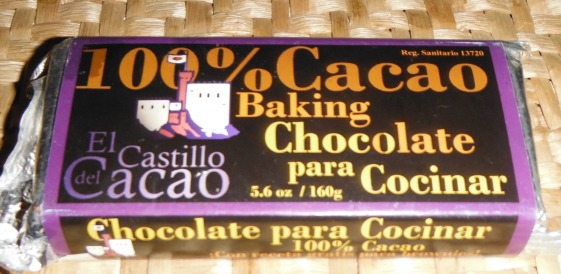
In gathering ingredients for the Lebherz version of mole, we were fortunate enough to have cooking chocolate from Castillo Cacao in Matagalpa, and we were even more fortunate that Pam remembered this fact.

Moles vary, and mine varied even a bit more, with thees slight modifications to the recipe:
  1. Because almonds are mentioned in the directions but not listed in the ingredient list, I guestimated that 1/3 cup of slivered almonds would work. 
  2. The biggest gumption trap that led me to delay making my first mole sauce by two decades was the need to roast peppers. This should have made the listing of one ordinary green pepper welcome news, but instead I was determined to employ this new skill. I was therefore pleased to see passilla chiles in a local grocery, even though I had to go to a separate store for corn tortillas. I roasted them according to the method I mentioned in my Busy Kitchen post last month, along with a half of a jalapeño we had on hand.
  3. The recipe calls for olive oil, for which I substituted Chipotle Olive Oil, also from L.O.V.E.
  4. Finally, the recipe calls for light rum, which we do not usually keep around. I almost substituted aged, dark rum from Nicaragua for a bit more complexity, when I had an even more brilliant (in my mind) idea: Kahlua.
I did not take any photos of the final product -- I expected it to taste much better than it looked, and I was correct -- but I did make a little still life of some of the more colorful ingredients (including the oil and vinegar and a beautiful onion from Colchester) during preparation.


I increased everything in the recipe slightly by about half, both so we could be sure to have enough for guests and so that we could have leftovers. I think I added more broth than necessary; in any case the result was more like a stew than a sauce -- a happier spot along the mole continuum for Pam, but thinner than I would have preferred.


The result was not as photogenic as the tableau above, but it was certainly delicious, served with rice, warmed corn tortillas, and of course beer. It was even better on subsequent days. We finished the chicken but have some sauce left over (yes, leftovers of leftovers), which I hope to fashion into some sort of champandongo.


If I ever find a source to a proper assortment of fresh chiles, I will try the Puebla-style recipe on Epicurious, perhaps modifying it to include the Lebherz secret ingredient. The sad assortment of peppers in our local markets make this highly unlikely, unless I treat the ingredients list as a shopping list for next winter's seed catalogs.


Which I might just do.

Tuesday, December 13, 2011

Three Sweet Words

As I wrote in the Tortilla Heaven post nearly a year ago, at the beginning of this project, The Well-Filled Tortilla is among my very favorite cookbooks. Often, when scanning our collection for a new recipe, I will grab this volume, even if I also take another from the shelf. It is organized by the main filling ingredients -- veggies, chicken, beef, seafood. This weekend, I started near the end and found a few favorites we had made recently. I was also surprised by the number of seafood entries, which I had not really noticed. I was especially surprised by the illustration of how to dissect a squid, which I found somehow unsettling.

I kept thumbing toward the middle of the book, when three words jumped out at me. Three words that I cannot believe I had not noticed together: tequila, sausage, and mole. (I always feel obligated to stipulate that mole is not a rodent in this context, but a savory, sweet sauce: mol-AY. The words were especially intriguing because we had a half jar of mole sauce left over from our recent Champadongo ecstasy.

This recipe (Tequila Sausage with Chocolate Mole Sauce, p 108) actually called for me to make sausage, but not in the gruesome way one might imagine. Rather, I simply mixed a pound of ground pork with minced garlic, rubbed sage, fennel seeds, cayenne, salt, and tequila. The recipe called for 2-1/2 pounds, but for just the two of us, a pound was more than enough. I cut back a bit on each of the other ingredients, except the tequila. Rather than prepare and cook it right away, I let it meld in the fridge overnight, so that the spices and tequila were absorbed.

Dinner this evening was then quite simple -- steam a couple soft tortillas (30 seconds in the microwave, rolled up in waxed paper), heated the mole sauce in a saucepan (though I guess a molepan would do), and then cooked the sausage with a bit of oil in a hot cast-iron skillet. I cooked the sausage until crispy, meanwhile chopping a cold tomato. The result: hot, spicy, sweet, salty, and not too heavy. Hmmmmm.