How It All Started

Bob Phillips

The title of this blog was inspired by one of my Spanish professor's at Miami University of Ohio, Dr. Robert Phillips, who died in the e...

Showing posts sorted by relevance for query brody. Sort by date Show all posts

Tuesday, June 11, 2019

Pepper-forward Pasta

When looking for a dinner idea yesterday, I went to the original intent of this blog -- making use of the unused pages in cookbooks we already own. I headed to our easy chair with The Well-Filled Tortilla and Jane Brody's Good Food Gourmet. Followers of this blog -- or those using the search box at the top of the screen -- will know that we have made very good use of both of these volumes (though most of our Jane Brody references are to her earlier Good Food volume.

Because I had made quesadillas (with cheese!) for lunch, I opened Brody's book first. Because I had recently purchased a few boxes of Rao's penne pasta, I looked at pasta entries in the index, rather than thumbing through the book at random. I quickly found Fusilli with Hot Sausage, and quickly decided that penne would be a very reasonable substitution -- especially since Brody grants "or similar pasta" in the ingredients list.

I followed the directions on page 224 pretty closely, except with regard to proportions. Having purchased a pound of hot italian sausage, I used it all for Brody's first step (my second; see below). I  removed the casings and crumbled the sausage as I cooked it over medium-high heat. I then put it into a bowl (it was lean, so no draining was required).

My step before Brody's first step was to roast the peppers. The recipe calls for a 6.5-ounce jar of roasted peppers. Since my adventures with Mexican mole sauces, I almost never purchase roasted peppers, preferring to cook them directly on the stove. In this case, I went a little overboard and roasted three large ones on the rarely-used oblong center burner. I had done this and placed the peppers in a sealed bowl for sweating while I worked the indispensable cast-iron skillet.

Roasting peppers, in progress. I let them get much
more charred than this.
At some point I heated a pot of water with a little oil and salt. I never rush a sauce, but it is good to have the water ready when it is time to cook the pasta.

While the peppers were sweating -- I added some olive oil to the pan, reduced the heat and slowly cooked one diced onion (I have no idea how its size compares to the called-for 1-1/3 cup) and two teaspoons of garlic.

Just kidding about that quantity of garlic:
My friend Joe has convinced me
never to measure garlic again.
After I scraped, seeded, and cored the peppers, I pureed them in a blender with a can of tomato paste (instead of 2 tablespoons) and a little olive oil. I often do this when substituting home-roasted peppers for those that are bottled in oil. At this point I started boiling the pasta.

Once the onions and garlic were softened, I returned the sausage to the skillet and added the puree along with a modest dousing of cayenne pepper and a small bag of frozen corn. Yes, frozen corn. Because Jane Brody said so. The sauce was to simmer for 10 minutes -- it was quite thick, so I added a little bit of Malbec. Never a bad idea.

Once the penne was al dente, I drained it and combined it in a bowl with the sauce and several finely-sliced scallions.

The result was more delicious than photogenic, which I expected. That is why I favored this space with in-progress photos, rather than the final dish. We will definitely be adding this to the repertoire!

Friday, February 18, 2011

Inaugurating the new oven

Our new oven was delivered and installed on Wednesday, but since we had plans on Wednesday evening, we did not have a chance to try it out until Thursday. After picking Paloma up from school yesterday we each grabbed a cookbook and starting looking for a good recipe with which to break in our new appliance. Paloma picked up Jane Brody's Good Food Book (she says she was in the mood for good food!) and selected Vegetarian Shepherd's Pie. This isn't a completely new recipe for us, as we make some variation of Shepherd's pie a few times a year, but it is usually loosely based on a recipe I clipped somewhere. Brody's recipe had a few things we don't normally include, for instance tomaotes and greens. But like any other time I make this dish, I don't really follow the recipe exactly anyway. In fact, Brody suggests that the ingredient need not be followed exactly, and that it is okay just to use up whatever vegetables are on hand. Taking that advice, last night's version included asparagus, green beans, baby onions, and garlic, in addition to the tomaotes and greens. We also threw in some soy-based "crumble" as a meat substitute. The instructions said to cook the vegetables in a pan, and then transfer to a 2-quart casserole. No My Friends! No I say! What could Ms. Brody have been thinking? If there was ever a job for the indepensible cast-iron skillet this is it. The vegetables were cooked in the skillet, and then the mashed potatoes were added on top of them, and then topped with shredded cheese, at which point the skillet when directly into the preheated 350 degree oven for 20 minutes. I believe all three of us had seconds of this dish, although James and Paloma both agreed that they prefer the recipe I usually follow, as it makes a bit of a gravy, which this one did not. I think I liked this one better, though.

Saturday, March 8, 2014

Foursquare Comfort Food

She was Italian; this dish is not.
This is rather a belated post, and I'm recognizing the advantages of blogging about food while the memories are fresh. Still, I'd like to share a new (to us) recipe I prepared more than a week ago.

True to the original intent of this blog project, I went took a book from our shelf and searched it for a new recipe. We have made such great use of Jane Brody's Good Food Book, perhaps the first cook book we purchased together. We are actually on our second copy, having worn out the first. Readers of this blog will know we make frequent use of it, but at 700 pages, we may never complete more than a tithe of its treasures.

For some reason, I was in the mood for pasta, but had no other criteria for my search than the use some of the spaghetti we already had in our cupboard. The index led me to Turkey Tetrazzini on page 363. The name was vaguely familiar, and since Brody highlights four main ingredients -- sphaghetti, turkey, cheese, and milk -- I assumed that the name had something to do with the number four, as in Carbon tetrachloride (CCl4).

Although the word "leftover" is used twice in Brody's short introduction, I actually went shopping for this dish, getting some thick slices of turkey from the deli counter. I did use a frozen green pepper we already had on hand.

I started by sauteing a half pound of mushrooms in butter,  then added a bit of flour and pepper (skipping the called-for salt) I stirred in two cups of milk and then added Worcestershire sauce (giving the dish an odd greyness). After this was thickened, I added a half cup of shredded Cheddar and a diced pepper (frozen from our farmbox harvest last year), and scallions. Into a casserole dish prepared with a bit of olive oil, I stirred in a half pound of diced turkey and half pound of spaghetti, which I had cooked while preparing the rest. I topped this with a mixture of Parmesan cheese and breadcrumbs. This I convected at 350 until evenly browned on top.

Thankfully, this dish has nothing to do with the toxic compound, and in fact is quite yummy. The name is an homage to the Italian opera star Luisa Tetrazzini, and I think its main advantage is that it lends an exotic air to what is a very mainstream suburban dish. So mainstream, in fact, that I instantly declared it fit for any kind of suburban club or senior-center gathering.

What I realized after the fact is that I might be the first person ever to go shopping for ingredients to make this dish. According to the same NPR story on musical leftovers from which I learned of the opera connection, I learned that turkey tetrazzini is commonly associated  with Thanksgiving leftovers, and this makes a great deal of sense. The online version of the story includes a recipe that sounds a little more interesting, with a bit of dry sherry (I should have thought of that) and a couple of spices.

A quick image search for turkey tetrazzini validates my decision not to post a photo. This is definitely a dish that is more appetizing in person than it is in a photograph!

Saturday, September 21, 2013

Not entirely unlike Jane Brody's Tricolored Chickpea Salad

When we made our meal plan at the beginning of the week, we had several onions, but had used them all by Thursday when I planned to make the chickpea salad from Jane Brody. It seemed silly to go to the store just for onions so I made due with what we had. Two carrots were sliced and boiled in our indispensable cast-iron dutch oven. To these I added some smallish potatoes, cut in half, and a handful of string beans, which were a substitute for the green peas the recipe called for. I cooked everything until the potatoes were soft, then added a can of drained and rinsed chickpeas. Here the recipe calls for sauteeing onions and garlic, and instead I just threw in a few pinches of garlic salt. I then added a dollop of apple cider vinegar and some fresh herbs. All was tossed together and then divided onto two plates. It was topped with feta cheese (in place of the Swiss Brody calls for). This was really good, and was paired well with our homemade Pinot Noir.

Wednesday, November 14, 2012

Local Endowment

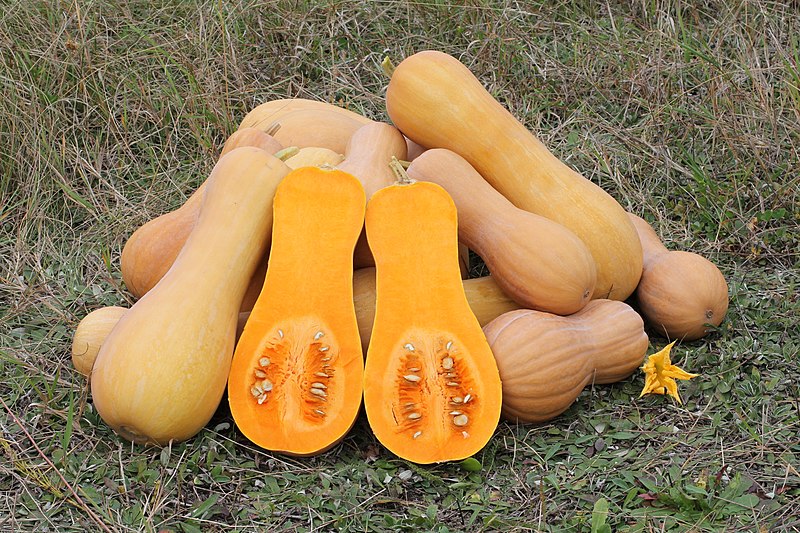
Wikimedia image of butternut squash
We ended our farm box season with a few squash on hand, and turned to Jane Brody for guidance on something new to do with the butternut -- that large, sweet, vaguely obscene member. Of the squash family. In searching for an image, I learned the local geography of the butternut's most common variety, the Waltham butternut, which was developed in Stow, Massachusetts and then introduced at the Waltham Field Station.

Looking in Brody's Good Food Book, we found "winter squash stuffed with apples and cheese" on page 401 -- these were all good ingredients we had on hand. (See all of our Jane Brody posts.) The recipe calls for two small acorn or two small butternut squashes, but we had one large butternut that was enough to feed us both.

I split it in two (as in the photo above) and scooped out the seedy part. I lightly oiled a baking sheet and placed the halves on it, flesh side down, in a 350 oven for 30 minutes. Then I sauteed a chopped apple and onion in butter. I then mixed these with ricotta cheese (replacing cottage cheese in the recipe) and some very good cheddar from Cabot. To this I added dried cranberries in place of raisins or currants. I pressed this filling into the pockets of the squash and baked another 20 minutes, flesh side up.

Pam liked this better than I did. I could see room for improvement. First, I did not cut the squash quite evenly, so taking the larger side meant that I took the somewhat half-baked side.More importantly, I do not think the ricotta cheese worked for me. It would have been better to use just the cheddar, or perhaps a mix of cheddar and Monterrey Jack. Most importantly, I used a red onion when I should have used yellow, and I should have cooked it a bit longer to caramelize and sweeten a bit.

I will definitely try this again -- either waiting for next year's harvest or perhaps with a store-bought squash. The meal fits in a good spot on the nutritious-delicious-easy-cheap trade-off matrix.


Sunday, December 1, 2013

Chinese Thanksgivikkah

Lovely Lilly offers insistent
affection throughout
the day. She is also
the chief tripping hazard.
Thanks to Yaqin Sun
for most of the photos
in this post.
Where to begin? Thanksgiving is always a special day for us, but this year was unusually bounteous, and we are especially grateful. We were fortunate to layer many new elements on a day already full of fond traditions around food and friends.

The tradition has developed over the past decade or so, with the day spent at the ancient, rambling home of friends along the Matfield River a few miles away. Since our doglet would pose a choking hazard to their dog -- and she would also be an annoyance and a flight risk -- we leave little Perry at home. We always plan a mid-afternoon respite trip back to our house, because this is a dinner that we know will be hours in the making and more hours in the enjoying.

The turkey arrived at our house on Sunday, a special addition to our weekly milk delivery from Crescent Ridge in Canton. No thawing questions arise, as we simply keep this very fresh turkey well chilled in a picnic cooler until we are ready. One of this dairy's many regional partnerships is with Misty Knoll Farms in Vermont, which provides delicious, free-range turkeys while caring for the land in northwestern Vermont. As in the past, we bring the turkey early, to roast in a standard charcoal grill. The turkey is first rubbed with a paste of finely minced garlic, olive oil, and paprika -- something we have done for years at the suggestion of Jane Brody's original Good Food Book.
Overlapping pans and dishes were a hallmark of this day; a kitchen both vast and cozy was the stage for a dance of cooking, cleaning, tasting and serving throughout the day. 
The stuffing also follows Brody's recipe in a very general sense, and preparations began early. James put two loaves of whole-wheat bread in a large bowl some time Monday, leaving it out to stale. On Thursday morning, the slices were cut into cubes, to which was added chicken broth, chopped celery, local cranberries, chopped walnuts, a couple of local eggs, and a package of sweet Italian sausage. Although this decadent concoction is called "stuffing," it is baked outside the bird, in two large casserole dishes.

Although we were aware that Hanukkah and Thanksgiving would overlap this year, it was not until we heard a Thanksgivikkah story on NPR last weekend that we realized just how rare this would be, why it was happening, and best of all -- the culinary opportunities presented by this coincidence. We opted not to brine the turkey in Manicevitz, but we did try two other recipes.

The first of these was a sweet-potato noodle kugel; we have often made kugels with apples, and were intrigued by this variation. I neglected to buy cottage cheese (and would not dream of buying any on Thanksgiving Day itself), so substituted a package of cream cheese. In place of a food processor, our trusty potato masher made quick puree of the softened sweet potatoes, with virtually no cleanup required. We also substituted Honey Bunches of Oats for corn flakes in the topping, combining them with finely chopped pecans. We wish we had remembered that one of several vegetarians at our feast is also highly allergic to nuts -- we will make this dish a bit differently next year so that this is a vegetarian option for all present.

The other Hanukkah-related addition was latkes with cranberry-apple sauce, inspired by the menu mentioned above, but using our own recipes. For the latkes, we beat two eggs in a bowl, then simply peeled and coarsely shredded in a couple of pounds of potatoes in. Adding a half an onion, cut into fine, long slivers and a bit of flour, it was easy to toss together a batter. Rather than squeeze the water our of the potatoes using a sieve, salt, or other method, we simply squeezed each patty as it was formed , before dropping it onto a cast-iron skillet with hot oil, and pressing it a bit to flatten. The sauce was a variation on what we call "recipe" cranberry sauce, though I have learned to use a small amount of good, aged rum rather than a large amount of cheap rum. With a bit of cardamon, this was a very pleasing brunch item, popular with the entire crowd.

Of course no Hanukkah celebration would be complete without a menorah, which burned brightly through the meal and beyond. Keeping with tradition of course, the candle was small and specially designed so that it would need neither trimming nor extinguishing.
No Thanksgiving feast is complete without a "kid's table," a tradition I would rather have avoided if we could, especially since one adult was at that table, which we preferred to call the "youth table." James felt a bit guilty about this, but remembered that we were both at a kid's table as recently as our 40th year! In any case, the young ladies at that table did very much seem to be enjoying themselves.

Local seafood prepared by our hosts helped to fill the middle of the day, as we nibbled on bacon-wrapped scallops and clam pizzas, along with the latkes and delicious Chinese snacks. Rob had also prepared a special polenta, in recognition of the fact that the main dish at the first Thanksgiving was probably corn mush.

Those snacks were part of the other special dimension of this year's celebration was the participation of two students from China. Yaquin is a BSU student who has studied both coffee and tea with James, and who has been in the United States just over two years. Jane is our daughter Paloma's roommate at CSW, who has been here for just a few months. Since Paloma has been to China and is learning Mandarin, it was especially good that they were able to join us. We enjoyed their company and they enjoyed being part of this very American experience.

Shopping together on Wednesday, we had gathered ingredients for delicious egg rolls (much more flavorful and healthy than anything I have had in restaurants), stuffed dumplings, and rice pudding. Their food and company will stand out as a special Thanksgiving memory for many years to come. And because it is 2013, very traditional scenes such as the one below are already circulating on the Chinese Internet. It is a small world, after all.
But wait! Don't forget dessert(s)!

Earlier this year this image of a "piecaken" went viral on Facebook.
Pam was intrigued, and is always up for a challenge, but something just didn't seem right about this. When a recipe online was found that began with store-bought pie (what!?) she began brainstorming and recipe searching in order to make a piecaken from scratch that would also include traditional Thanksgiving flavors (and wouldn't look quite so gross). The quest ended with this recipe for a pumpkin spice cake and this one for a no-bake pumpkin pie. Both were made with pumpkin puree from a pumpkin, not a can. Two layers of the cake were baked, then the pumpkin pie (without the crust, so it was really pumpkin custard) was prepared using the same size pan. Parchment paper was placed inside the pan first to make removal easy. The custard was kept chilled until just before serving time, then was sandwiched between the two layers of cake. Finally the homemade cream cheese frosting was added to the top. It was one of several dessert choices, including traditional pumpkin pie, apple pie (pictured below with the piecaken) and bread pudding all made by our favorite teen baker, Clara; as well as a rice pudding brought by Yaquin and Jane. The piecaken was delicious! Flavorful, full of texture, and not too sweet, but still decadent enough for a special occasion dessert. All other desserts were also given high praise.

All in all an especially memorable Thanksgivikkah feast with fabulous food, and wonderful company.

Tuesday, October 1, 2013

Winter Squash Stuffed with Apples and Cheese

We've gotten several butternut squashes in our CSA box over the last few weeks, so I reprised last spring's Cream of Squash soup, as well as trying our a new recipe. This delightfully autumnal meal took a bit of time, but was not especially complicated. The squash was cut in half lengthwise and seeds were removed. The two halves were baked, cut side down, in a 350 degree oven on a greased baking sheet. While they baked I put together the stuffing which consisted of sauteed apple and onion (one each), two big dollops of cottage cheese and about 1/2 c. of grated cheddar cheese, a squeeze of lemon juice, a tablespoon of raisins and a sprinkle of cinnamon. The stuffing was placed into the squash cavities and then everything was put back into the oven, covered with foil, for about 20 more minutes.

I got this recipe from Jane Brody's Good Food Book. Brody's note says she got it from The Moosewood Cookbook.

Wednesday, February 2, 2011

Oprah's favorite Turkey Burgers

Reader's of last year's "Celebrating the States" blog know that I read Living Oprah by Robyn Okrant for my Illinois book. Okrant followed all of Oprah's advice for one year, and prepared some of her favorite recipes, including the Mar-a-Lago Turkey burger. I recall that Okrant said that she spent about $50 on some special  ingredients, including some hard-to-find Major Grey's Chutney, in order to make these. She did rave about them though, saying both she and her husband loved them. I decided to try making them, but I used the fruit chutney that was already in my cabinet. I imagine Okrant probaly also had to buy the Chipotle Tabasco sauce that the recipe calls for, but that is already a staple in my house (henceforth known as a "staple on Maple" because we live on Maple avenue, plus, it rhymes).So although we had to buy a Granny Smith apple, and celery for this, we didn't spend anything like $50. I followed the instructions to saute the apple, onion, and celery, and then mix all the other ingredients together and let it meld together for two hours.This really allowed the flavors to come through, and the fruit chutney topping gave this just the right amount of sweetness. The celery and onion also gave it some crunch providing all that texture I like. I think turkey burgers are best when they are prepared with something that has fruit in it. The turkey burgers I made from Jane Brody's recipe while good, didn't have the sweet flavor. One thing Brody said though, is that you can't think of turkey burgers as hamburgers, and she is right. If you want a good ol' hamburger, prepare it your favorite way and enjoy, but don't try to prepare a turkey burger the same way. You will probably be disappointed.

Saturday, January 15, 2011

Recipes - Week 2

I wound up making two new recipes today. When I realized that it was the 92nd anniversary of the Great Boston Molasses Flood I decided to make some molasses muffins and chose Apple Streusel Walnut muffins from the Crosby Molasses Company website. I like things with a lot of texture and the combination of apples, nuts, and molasses gave this a good mix of flavor and texture - moist, yet chunky. James, Paloma and I all liked these, and they only took about 20 minutes to mix and 20 minutes to bake. They went well with coffee and with milk.

Earlier this week we experienced a power outage, so I had thawed some ground turkey figuring that, since we have a gas stove, I would be able to cook turkey burgers on the stove top. I intended to invite some friends who have an electric stove to come over so we could all have a hot meal, but the power came on well before dinnertime, and my friends invited us back to their house for lasagna, which had been the plan in the first place. So, I still had the thawed turkey and was running out of week, and decided to see if I could find a new turkey burger recipe. Jane Brody's Good Food Book to the rescue. This cookbook is an old favorite, and we are on our second copy of it, having worn out the first. Brody's turkey burgers call for bread crumbs, chopped onion, ketchup, lemon juice, Worcestershire sauce, soy sauce, paprika, Tabasco sauce and black pepper. She suggests eating them on pita bread  with lettuce and tomato. I made the following changes to her recipe:

         When I squeezed our almost-empty ketchup bottle the plastic cracked, so I threw it away and
          substituted barbeque sauce
          We did not  have soy sauce so I put in extra Worcestershire sauce instead
          I used a plain old hamburger bun rather than pita bread

These were juicy and tender, and had a lot of flavors. They were especially good with the sweet potato fries I served with them. James and I both liked them. (Vegetarian Paloma did not join us.) I think, though, that I will stick with my old favorites for turkey burgers in the future: cheddar cheese with barbeque sauce, or the Apple Turkey Burgers I made last summer in honor of Arkansas Day.

Friday, February 24, 2012

Celebratory Loaf

For Thursday's dinner, we had decided to try a turkey loaf from Jane Brody's Good Food Book, which regular readers will know is a frequent favorite for simple, good foods.

At the grocery that morning, I had picked up one extra treat, a mango. Just a couple months ago, we had bought a mango splitter, Kevin Walzak's miracle device I had heard about on NPR seven years ago. Mangoes are the most readily available of the many tropical fruits I came to love during my 1996 summer in Rondônia, but I always make a huge mess with them. We are always cautious in our kitchen-gadget purchases, but the delay-to-cost ratio was pretty high on this one, and I was glad finally to have acted on a long-overdue and simple desire. My efforts lacked the symmetry of the Oxo stock photo, but I did have much better results than I have ever had with Mangifera indica.

Back to the main course -- Terrific Turkey Loaf on page 440 promises to be rich but low in fat, and it was. It begins with sauteed garlic, celery, leeks or onions, sweet red peppers and mushrooms. These are mixed with ground turkey, egg, fresh parsley, and bread crumbs and placed in a lightly-oiled loaf pan. An interesting innovation is that the loaf pan is placed in a larger pan, into which boiling water is poured to a one-inch depth, to keep the humidity in the oven high so the loaf does not dry out.

I departed from Brody's instructions in a few ways. First, I do not think I reduced the vegetables quite enough, and for this reason I chose a small casserole instead of a loaf pan. And though I looked at the recipe list several times and saw the pinch of nutmeg, I somehow forgot to add it. Finally, instead of the "fresh bread crumbs" of one slice of bread, I used packaged crumbs, and probably not enough. I think this is what made the loaf a bit soupier than it should have been.

The result was delicious, though a bit slow to cook. I think fresh bread crumbs would have worked better and allowed this to firm up better, and I think leeks and that pinch of nutmeg would have made the flavor even better.

What made this celebratory? At the very end of the work day, Pam received a letter from our provost, informing her that her application for promotion -- from Associate Librarian to Librarian -- had been approved. Academics only get a couple of promotions over their lifetime, so this was a big deal.

How to celebrate? A common impulse is to drop everything and run out to eat, and at times we have done that. But we did not even discuss scrapping a perfectly good dinner plan for something that would cost more and probably not taste as good. Instead, Pam got out the good silver and put a bottle of 2004 Vintage Rose from Westport Rivers in the fridge while I started the loaf. We had purchased this bottle for Valentine's Day, but careful readers will recall that for that meal we decided on a peppery Savignon Franc from Sakkonet. The line "pink champagne on ice" is now stuck in our heads, but thankfully the fruity notes of this champagne-style rose are balanced, and the wine went surprisingly well with the loaf.


Incidentally, our favorite vineyard began as a hobby in the year before we got married; a bottle or two may be on hand when we celebrate our own silver anniversary in early May!

Thursday, September 1, 2011

Company Rice and Beans

Another recipe from the wonderful Jane Brody's Good Food Book. We were able to use some of our CSA farm box bounty in this delicious dish - which I must say is suitable for company.

We used up every grain of the rice we had left in the house to make this. The recipe calls for 3 cups of cooked rice, which means 1 cup dry rice, and 2 cups of water. We knew we had rice in several different containers and hoped that the small amounts we found in each would equal a cup when added together. The goddess was with us as we watched the last of the rice top off the 1 cup measurement. While the rice cooked I gathered the ingredients for the beans, which included onion, garlic, tomatoes, what I thought was a zucchini, fresh oregano, and one can of black beans. Starting with the chopped onions in my indespensable cast iron skillet, I cooked them until soft, then added the minced garlic. Tomaotes, of several colors (red, orange, yellow) were chopped and added, and then I cut into the zucchini, and discovered it was really a great big cucumber. No worries, that yellow thing from the farm box that looked like a ufo I knew was some sort of  squash so I made an executive chef decision and substituted it. Finally I added the drained black beans (Brody says black, red, or garbanzos all work equally well). I left this to cook on low heat until the squash was soft enough, then served over the rice. Topped with shredded cheddar, this is a visually appealing, as well as appetizing, and healthy dish.

Thursday, December 3, 2020

Zucchini Frittata

 During the Thanksgiving weekend two different friends each gifted us with a dozen eggs. In addition we received our usual 18 eggs with our weekly dairy delivery from Crescent Ridge Farm so we set out to make some egg-based dinners. First up was was our annual post-Thanksgiving sweet potato and turkey hash topped with fried eggs. Last night's recipe for zucchini frittata came from Jane Brody's Good Food Book (which has an entire section devoted to egg-based main courses). I chose this one because I had some shredded zucchini in my freezer from this summer's harvest from my garden. I also had all the other ingredients I needed on hand.

I started by mincing two garlic cloves (also from my garden) and chopping one onion. I sauteéd these in a lot of butter for about a minute in my indispensable cast-iron skillet and then added the thawed and drained zucchini. Next I beat six eggs to which I also added a bit of whipping cream, dried basil (also from my garden) and some shredded parmesan cheese, and added the mixture into the skillet. I cooked over a medium heat until the eggs began to set, at which point I added some more parmesan cheese to the top and moved the skillet to the oven which I set on broil. Once the top was nicely browned and puffy I removed it and let sit for two minutes before serving.

This was easy, flavorful, and had a lot of texture.


Tuesday, July 18, 2017

New Potato Salad


I see so many good recipes on my Facebook feed that I sometimes lose sight of the original intent of the "Nueva Receta" project - to make good use of my cookbooks. So I went old school with the bag of red-skinned potatoes I bought last week at the Fairhaven Farmer's Market and found a recipe on my cookbook shelf from Jane Brody's Good Food Gourmet. I followed the recipe almost as presented. I didn't have any carrots so I skipped that, and I left the sugar out of the dressing. It just seemed unnecessary. As the recipe indicates this was quick to make. The yogurt made it especially creamy and it had a lot more flavor than what one expects in a potato salad. The caraway seeds really seemed to be the key.

Friday, June 13, 2014

12-Clove Garlic Chicken

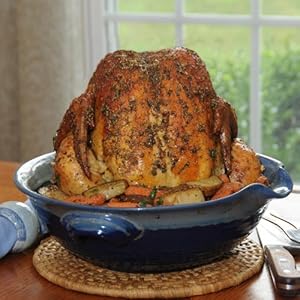
I adapted this recipe from the Jane Brody's Good Food Book "40-Clove Garlic Chicken" recipe. We didn't have 40 cloves of garlic, so I just worked with what I had. I used our super-cool pottery dish for baking a whole chicken.


I filled the bowl with one chopped onion, 12 garlic cloves, 4 pieces of cut celery, some parsely, garlic salt, pepper, nutmeg, and tarragon. There is a tube in the middle of the bowl upon which the chicken sits - this was filled with vermouth, and yet more vermouth was added to the bowl. The chicken was placed over the tube and then brushed with olive oil and additional vermouth. I covered the chicken with foil and placed it in a 325 degree oven for 1.5 hours, as indicated in the recipe. The chicken was not nearly done at that point, and James advised me to remove the foil. We also bumped the oven up to 400. After about 30 more minutes the chicken was done. It was juicy and full of flavor. We enjoyed this with a crusty multi-grain bread, some baked potatoes and some Pinot Grigiot.

Wednesday, August 31, 2011

Ginger Chicken and Chickpeas - aka "Chicken a la Irene"

As hurricane Irene struck the east coast on Sunday, James and I were grateful to have a gas stove, knowing that when the electricity went out we'd still be able to use the stovetop to cook a hot meal. Every report we read indicated that most of our neighbors were without power, and we waited, expected, ours to go out at any time. It never did. Among the lucky few who had power the whole storm, our biggest problem from the heavy winds was losing one big branch from our walnut tree.  Nevertheless, the storm was severe, and we were not about to go out in it to get any ingredients. We chose a recipe that we could make with things we had on hand, or could be easily substituted. From Jane Brody's Good Food Book we selected Ginger Chicken and Chickpeas. We thawed some chicken breasts from the freezer, soaked them in lemon juice and water, and then browned in our indespensible cast-iron skillet. The chicken was removed from the pan, and then it (the pan) was used to sautee the onions. Once the onions were soft we added ground ginger (the recipe called for fresh, but we made do), cumin, cardmom, coriander and a pinch of red pepper flakes. The chicken went back to the skillet along with a can of drained and rinsed chickpeas, a cup of water, a teaspoon of cornstrarch, and a few dashes of worcheshire (the last three ingredients were a substitute for broth). After bringging the water to a boil, the pan was covered and set to simmer for 30 minutes.

This was a good, hearty meal on a day that felt more like fall than summer. The chicken had a definite kick, but I think the fresh ginger would have provided the more spicy flavor I prefer. I think I was too parsimonious with the red pepper as well.

Tuesday, May 24, 2016

Rice Pizza

Rice Pizza? What could that be?

Following some nice tortillas Sunday and Asian carry-out on Monday, we found ourselves with a bit of a surplus of rice at Casa Hayes-Boh, and took to the cookbook shelf to see how we might use it. My first inclination was to reprise the Tabasco-enhanced Country Captain Chicken we had enjoyed a couple of weeks ago, but since chicken had been featured in both the Asian dinners and the leftover Asian lunches, Pam suggested pulling the essential Jane Brody's Good Food Book from the shelf.

I found a lot of entries under "rice" in the index, including all kinds of items about rice -- its preparation, nutrition, measurement, and so on. But I also found the intriguing "Rice-Crust Pizza" on page 480 and decided to give it a try, modifying the quantities, mainly by sheer guesswork.

I began by beating one egg and combining it with the cooked rice (we had just a bit more than a cup and a generous pile of shredded mozzarella). I applied olive oil to a glass pie pan and pressed this mixture into it. I then placed the pan in a 450F oven for 30 minutes.

Then I combined tomato sauce (after opening the wrong can, I pureed one can of diced tomatoes and a can of tomato paste to get a thick sauce), dried oregano and basil, and freshly minced garlic. When the crust was somewhat browned, I spread this sauce on generously (having once worked at a pizza place where sauce was rationed, I do not like to skimp!). I then added some sliced mushrooms (and favorite topping would do) and freshly shredded parmesan.
Crisis averted! While it baked a further ten minutes, I set about to open the inevitable Malbec, breaking a corkscrew in the process. We have been cursed with poorly-made corkscrews and can-openers of late, but we are not to let a simple failure get between us and a nice wine pairing. After a miserable attempt with channel lock pliers, I retrieved our spare cork  jack from the car and wrested the cork from the bottle.
Victory is ours!
We then removed the small pizza pie from the oven. Having the cheese IN the crust made for a nice extra bit of crunchity goodness. We'll be doing this again, I'm sure!

Sunday, July 28, 2013

Sputnik II

Careful readers of this space may recall my introduction to the vegetable kohlrabi (COAL-ROBBIE or COAL-RABIE) two years ago, in a post entitled Kohl-whatee?, in which I compared the German turnip (as it is also known) to the Soviet satellite that scared the Eisenhower generation into raising taxes for NASA and that was nearly as edible.

When our orbit crossed that of the cabbage's humble cousin this year, Pam went to the shelves and found two possibilities, suggesting that I choose one to prepare. The winner -- as she often is -- was Jane Brody, whose Good Food Book includes a kohlrabi salad on page 544.

NOTE: This recipe calls for two hours of chilling time.

This is quite a simple salad, which calls for 2-1/2 pounds of kohlrabi bulbs and 2 small white onions. Since I had just one medium kohlrabi (it seems like the singular should be kohlrabo -- like biscotto -- but it is not), I used just a quarter of a medium yellow onion. I chopped the onion finely and put it in a bowl and then trimmed and peeled the kohlrabi. I sliced it into 1/4-inch sticks about two inches long and put them in boiling water. The recipe calls for boiling at one minute; I accidentally left it a bit longer, but no harm was done. Since this is related to cabbage, I can imagine over-boiling would release unpleasant sulfurs. I then rinsed the kohlrabi under cool water in a sieve.

In a separate bowl, I whisked together the dressing. The original proportions are shown -- I used about half and could have done with a bit less.

1/2 c tarragon wine vinegar (I used red wine vinegar and 1/2 t of dried tarragon)
1/4 c sugar
2 t sesame seeds
1/2 t minced fresh ginger (this was the exception -- I used about a teaspoon)
1/2 t hot red pepper flakes
1/2 t ground black pepper
1/4 t salt

I tossed this together with the vegetables and then realized that the last step was to chill. We were ready for dinner when I noticed this, so we settled for 20 minutes or so. More would have been better.

Readers of this space also know that we are fans of elaborate oils and vinegars from our friends at Lebherz in Frederick, Maryland, but I used a generic wine vinegar in this case. I am looking forward to recommendations from L.O.V.E.

The intention of this recipe, is to use hot spices and cold temperatures to help the diner forget about the kohlrabi. It actually works pretty well,  and the result reminded me of a hot slaw I made a few weeks ago with actual cabbage. This was a decent side dish for our crab cake sandwiches; the pairing with a semi-sweet wine was not ideal, though I am not sure what I would recommend -- perhaps a peppery Cabernet Sauvignon will be in order next time.

Sunday, June 30, 2013

Banana Rhubarb Crumble

Ahh...the first farm box pick up of the season. We got a lot of leafy greens, a jar of honey, and a bundle of rhubarb. I turned to Jane Brody's Good Food Book to find the recipe I had made once before for a church supper. I used the two especially ripe bananas we had on hand (cut into slices), and two big stalks of rhubarb. Each of these were chopped into bite size bits. The fruit was mixed with 2 T. sugar and a bit of cinnamon and nutmeg. This mixture was placed in a pie pan and then topped with the crust mix which consisted of 1/2 c. flour, 1/2 c. oatmeal (substituted from the graham crackers called for in the recipe) 1/4 c. butter (cut in), one egg and 1/4 c. milk. I sprinkled a bit more sugar on top of the crust and baked in the convection oven at 375 for 25 minutes this turned out to be a wonderful combination of flavors and other sensations. The sweet bananas were a perfect complement to the tart rhubarb. My idea to top it with vanilla yogurt was inspired. I loved the contrast of warm and cold, and the variety of textures.

Friday, May 3, 2013

Cream of Squash Soup

We used up the very last of last year's CSA bounty with the squash we still had in the freezer. I adapted a recipe from Jane Brody's Good Food Book to make just enough soup for the two of us to have with our grilled salmon.

I started by chopping half an onion, and mincing a clove of garlic and sauteing these in some butter in a saucepan. Fresh ground pepper was added, then a cup of organic chicken stock. The rather small portion of squash we had was added next, and everything was simmered for a few minutes before one cup of milk and a dash of nutmeg were added. Everything was then placed in the blender to puree. Then back to the saucepan to heat before serving. This was a good, easy soup to make and can easily be made vegetarian by using vegetable stock in place of chicken stock.