How It All Started

Bob Phillips

The title of this blog was inspired by one of my Spanish professor's at Miami University of Ohio, Dr. Robert Phillips, who died in the e...

Wednesday, May 15, 2019

Posibilidades Pinoleras

(Nicaraguan Possibilities)
Gallo pinto photo by
Aryana Azari
Careful readers of this blog know that its original intention -- and a goal we still pursue to some degree -- was to reduce the number of untried (indeed, unread) recipes filling the pages of our modest collection of cookbooks. Like most people who have cookbooks, many of ours had seen only one dish make it from the page to the table. With some favorites this might have happened a dozen times, perhaps with smudges of sauce adorning a single page of an otherwise pristine cookbook. So, this blog pushes us back to the shelves and into those unturned pages.

But this Matador Network blog post does just the opposite. In 10 traditional Nicaraguan foods the world should know about, photojournalist Aryana Azari draws us toward dishes for which the dozens of cookbooks on our shelves offer no guidance at all. Neither, in fact, does this post provide any actual guidance, as our posts linking to various online recipe sources do.

Rather, this post advises us of 10 dishes we should try when visiting Nicaragua, without providing recipes. I have tried only a few of these, including the ubiquitous gallo pinto and nacatamales prepared as a group activity. I have had indio viejo a few times at restaurants and have no idea how it is made. Most of the rest of these are variations I have not seen or dishes that might be very localized, because they do not look at all familiar. I am relieved, I must admit, to have avoided the tripe soup, though I have enjoyed some other soups that feature root vegetables that were not familiar to me before my Nicaragua travels, such as malanga.

Since recipes are not included, an ideal use of this article would be to carry it on a future visit to Nicaragua, to use as a sort of checklist. Completing the list would reward a traveler with opportunities to find places and people otherwise not encountered, as some of these dishes are quite localized.

For me, the flavor of this post is bittersweet -- sweet with the memories of friends, places, and foods -- but bitter for the separation resulting from the violence of its regime, about which I have written in detail on my main blog at #sosnicaragua.

Pinolillo / Pinolero 

Among the photos used in the Matador Network article is one from a user named pinolero. (Another is from a user named nicaraguitas, the significance of which is explained in my #sosnicaragua post.) Pinolero is a way of describing a person as very Nicaraguan. An awkward equivalent in the U.S. might be "apple-pie American" but I cannot think of anything more precisely parallel.

During our 2016 visit, my friend Doña Petrona -- who always hosts a few of my students and a big meal for my whole group -- provided us with a lesson in making this national drink.

All of the ingredients are grown locally and ground together.
Historically, this would be done on a stone metate,
in a process that adds mineral nutrients.

From grains of corn, nibs of cacao (chocolate), and some
spices emerge a powder that is stirred into hot water
for pinolillo.

Honorary pinolero, stirring the pot.
Painted Rooster

Gallo pinto -- the dish whose photo above I swiped from Azari for this post -- is not something a traveler will have to seek out. If you are in Nicaragua, it will find you. At virtually every meal -- breakfast, lunch, diner -- it will be available. Her photo includes two fruits of note: Bananas or plantains are served with most meals, and in a lunch buffet they will be offered in a few ways. Among the most common is madura, meaning ripe and baked. Also on the plate is an avocado, a fruit that grows quite comfortably alongside coffee.

I have written about the unusual name of gallo pinto -- which has a Rhode Island connection -- on my main blog at painted rooster. I mention a recipe that is on our cookbook shelves but that I apparently have never prepared, in part because I usually have plenty each January. Since I am now at my point of maximum separation from Nicaragua -- 16 months and counting -- I will make this soon, probably for breakfast.

Tuesday, April 9, 2019

French Onion Sandwich?

From the New York Times recipe pages comes the sandwich version of one of our favorite soups: French Onion. We met in French class, but that is probably not why we like it so much. Could be the cheesy salty sweetness of it. And although we make a lot of complicated soups, our go-to in this category is the frozen blocks from Trader Joe's that transform magically into a layered soup in the oven.

Pam mentioned this recipe when we noticed the Gruyère I had purchased at the very same store --- a cheese introduced to us years ago by the lovely couple from whom we rented our first home in Bridgewater. Since Trader Joe's is a schlepp from here, they would ask us to pick up a package whenever they knew we were headed there.

The recipe is quite simple; it requires a bit of patience but no complicated technique. I sliced a few onions as thinly as I could, and cooked them on medium-high heat, covered for a few minutes. The key was then to lower the heat, uncover, and cook for 20-25 minutes more. For the first half of this, an occasional stir was needed. For the last several minutes, more frequent stirring and steady lowering of the heat was helpful. The result was a darkening, sweetening, and roughly 50 percent reduction in the onions:
Notice I used our enamel pan with a silicone spatula. I would normally use our indispensable cast-iron skillet for this kind of thing, but as he onions got jammier, I was glad to have these tools, to get every smidgeon out and not leave a mess.

I then shredded the cheese -- more than the 4 ounces suggested, as I always do -- and mixed it in a bowl with the caramelized onion. The result was not pretty, so I was pleasantly surprised when my photo of the final result turned out better than the photo posted by NYT on the recipe page. The golden-hour setting sun at our beach house was responsible for that, I think.

Lagniappe

It was a Gruyère purchase that got us into this meal, but right before I started, I noticed that I had only seen Gruyère at TJs, but that I had picked up some fancy cheddar instead. This will be a good excuse to make these again soon. I will also have mustard in some form for dipping, as both the recipe and one of my friends suggest. So it will be EVEN MORE BETTER.

Friday, April 5, 2019

Salmon Provençal

Lucky Day -- my
fishmonger
ticket showed
my birthday
#Maythe4thbewithyou
As we have started spending most weekends (and the occasional weekday evening) at our Fairhaven house near maritime New Bedford -- where we even have a favorite fishmonger -- it is rare for us to eat seafood at our landlocked home in Bridgewater. It is even rarer that we would buy seafood here, so far (almost 20 miles) from the ocean. (This is somewhat tongue-in-cheek, but increasingly true.)

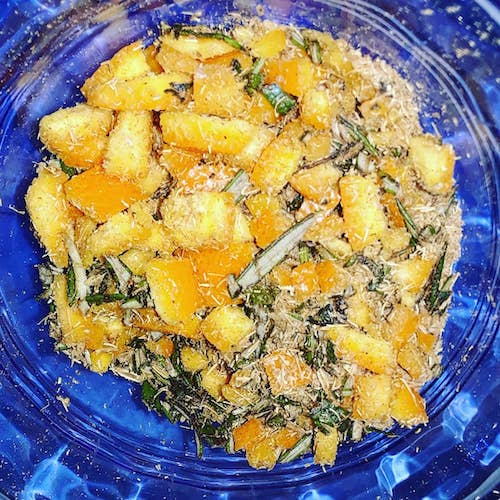
Every once in a while, though, circumstances lead to me bringing some seafood to Bridgewater, and when I suggested that I might do so today, Pam looked up a couple of NY Times salmon recipes she had saved. When she read the ingredients list to me, I decided to try Provençal Salmon With Fennel, Rosemary and Orange Zest. The recipe's title is essentially its shopping list, though I'm not sure what it has to do with Provence. 

Fennel, rosemary, orange zest
I followed the recipe rather carefully, including asking the expert at Kyler's Catch to skin the salmon fillet I had chosen. I do not bother with this step when grilling, but since the recipe called for it, I did so, and I learned previously that the combination of super-sharp knife and years of experience means that the job is done quickly and efficiently in the shop.

For the two of us, I used a single, one-pound fillet. I did not divide it until the very end, when I tested it for doneness. Whenever I divide a fillet, by the way, I do so crosswise so that we both end up with the same curve from thick to thin.

I preheated the oven to 400F and then combined the titular flavorings in a small bowl after grinding and mincing them myself. The combined aroma was so beautiful that I paused to take the bowl to Pam so she could appreciate a wafting before the cooking began.
Ready for a hot pan
I lightly applied salt and pepper to both sides of the fillet, and then pressed the spice mixture into one side, being careful to cover it. I then heated our indispensable cast-iron skillet and added oil and butter, heating a bit further. I could have let the pan get just a bit hotter, but it was sizzling decently when I put the fillet in -- orange-spice side down. I carefully flipped it after just over a minute, and a nice crust had indeed formed.

The recipe calls for a non-stick skillet, but seasoned cast-iron is preferable to the Teflon-style coatings, especially since this goes into the oven once the bottom has been seared and the fillet turned once. I kept this in the oven for 6 minutes before dividing it to check doneness. It was perfect after a total of 8 minutes.
Sizzling, crusty side up
The result: even though this was quick and easy, it was among the best salmon dish we have made, and we have made a lot of salmon dishes. This paired beautifully with mashed potatoes (which I prepared using a technique Pam recently posted), an orange (from whence I had garnered the zest), and Malbec. 

Lagniappe

I don't know how I failed to include a map in the original post! Provence is the southeast coast of France, nestled against the Mediterranean and Italy.

Tuesday, April 2, 2019

Khachapuri-Georgian Cheese Bread

Two years ago we had a Geology student from Georgia (the country) stay with us for a semester. Luka also came back last spring and stayed again for a few weeks. We shared some good times and he introduced us to Churchkhela (aka Georgian "Snickers" bars). I immediately thought of him when I saw this story from Gastro Obscura about Khacahpuri. I sent him the link to the story and asked how to make it, and he replied with this link . That was over a year ago, and on Friday I finally made this tasty dish for dinner. I started on Thursday night by making the dough in our 21-year old bread machine.

The recipe indicated that the dough could be made ahead of time and refrigerated. Once I was ready to use it, I broke it into fourths and rolled each quarter out and then shaped into a "boat"with points on each end. I filled each with a mix of shredded Fontina and Parmesan cheese and baked at 450 for 15 minutes on our baking stone - I eschewed the parchment lined baking pan called for in the recipe. This made for an especially crispy crust. The bread was then taken out of the oven and I used a spoon to make an indentation into the middle of each in order to crack eggs into them, then baked again until the eggs were cooked. You can see from the photos below that two of the "boats" ended up with double-yolk eggs.

Bread with cheese after initial baking


The double yolks were just a bit of luck. Each boat had only one egg cracked into it.

Prêt à manger!
As the recipe indicated, I left the whites a bit runny and mixed them together with the cheeses before eating. These were really filling. James and I each ate two (one each single yolk, and one each double yolk). We would easily have been satisfied with one, but it didn't seem as if these would keep very well for leftovers, so they were eaten all in one sitting.

Bloggers and their muse
Luka Adikashvili, May 2017
James adds: Delicious indeed, and filling, as Pam wrote. A late breakfast the next day was strongly indicated.

Wednesday, March 20, 2019

Berry Berry Basil

Pam has made Basil Blackberry Crumble a few times before, because she likes berries and loves basil. Even though Barbara Kingsolver and her family include it as a summer dish in Animal, Vegetable, Miracle, I decided I should make it for St. Patrick's Day, to complement the shepherd's pie she would be making. I got lazy, though, and did not make it until the following day.

Doing this out of season meant that I settled for doing a half-recipe (and honestly a bit less than half), since blackberries in this season are not bounteous or inexpensive. So I used a pie pan (Pam's suggestion) instead of a casserole, but otherwise followed the instructions above. For the balsamic, I used a pomegranate-infused balsamic from our friends at L.O.V.E. in Frederick, Maryland.

I got it all ready before Pam made the next evening's dinner, and then cooked it while we ate.
The result was delicious and would indeed have paired well with the shepherd's pie. It was equally delicious with a cool glass of milk after a dinner of BLTs and Malbec.

Tuesday, March 19, 2019

St. Patrick's Day Shepherd's Pie


We are low-key celebrators of St. Patrick's Day. I (Pam) have some Irish heritage on my father's side, so we wear green, and admonish everyone to do the same. (Everyone is Irish on St. Patrick's Day!) We also eat an appropriate meal, generally one featuring potatoes. This year's repast was Shepherd's Pie made with a recipe from the New York Times Cooking Page. 

I started by peeling, cubing and boiling 3 large potatoes. While they cooked I peeled and diced 2 carrots, one onion, and 4 garlic cloves, and shredded a cup of cheddar cheese. 

When the potatoes were ready to mash I drained the water and put them back in the pot, and let them sit while I melted 6 tablespoons of butter and cooked with 1/2 cup of milk in our indispensable cast-iron skillet. Then I added the butter/milk mixture to the potatoes and mashed together, and then stirred in the shredded cheddar, along with a bit of salt and pepper. A taste test told me that this is a method I should use in the future for preparing mashed potatoes. They were way tastier than usual. The potatoes then waited while I prepared the rest of the dish.

The cast iron skillet was put back to work to sauteé the onions, garlic, and carrots in 2 tablespoons of butter. Once the onions were translucent I added a pound of ground beef and cooked until it was no longer pink. At this point the recipe calls for a can of tomato paste. I used some left over tomato sauce instead. It also calls for some beef stock, which I totally missed. So even though I saw it on the list of ingredients and had James buy some, it never made it into the dish. Finally, I added some rosemary leaves and thyme before spreading the mixture evenly across the skillet. This was topped with the mashed potatoes, and again spread evenly. The skillet then was placed in a 375 degree oven for about 25 minutes, at which point the potatoes were a lovely golden brown. I let the dish sit for 12 minutes before serving. This was divine. Wonderfully tasty, with a lot of texture. It made for lovely leftovers the next day as well.

Monday, February 25, 2019

Cabbage with Apples, Onions, and Caraway

This one comes from the New York Times Cooking Page, and was selected because I had some leftover cabbage from the cole slaw James made last week, and an apple that needed to be eaten soon, or be composted. Fortunately I already had the other ingredients (onions, celery and caraway) on hand. The recipe also called for sprinkling sliced scallions on top before serving, but that would have required a trip to the grocery store, so I skipped that part.

I started by cutting the 1/2 head of cabbage into strips and cooking in boiling salted water for less than one minute. This was drained and rinsed in cold water.

Next I sliced the apple and onion and cooked with salt and pepper in our indispensable cast-iron skillet. Once they were browned I added the celery and caraway seeds. All of this was placed into a casserole dish with the cabbage and cooked at 400 for 10 minutes.

It made a fine side dish to accompany a family-favorite, comfort-food, hamburger-helper type meal.

I wouldn't go out of my way to prepare it again, but it was an excellent way to use up produce that otherwise would have gone bad.