Most of November has been quite warm here in Massachusetts. One might say "unseasonably" so, but based on the last 10 years or so, I would say, it has become, rather disturbingly, pretty normal. Anyway, yesterday the weather actually turned cold, and grey, and so it seemed that chowder season was finally upon us. I took the opportunity to make use the last chicken breast that was in our freezer, along with the organic yukon gold potatoes we purchased recently to prepare some comfort food for my sweetheart and me. I have made a lot of chowders before, so I figured I'd done it enough that I could create my own. After defrosting the chicken breast I diced it into small pieces and cooked them in my indespensible cast iron skillet in a bit of canola oil. Meanwhile, I boiled 2 cups of water and dissolved two teaspoons of "better than boullion" into it. To this I added 2 cups of lowfat milk, the cooked chicken, 5 small peeled and diced potatoes, a diced onion, a minced garlic clove, a bay leaf, and a bit of sage, salt and pepper. Once it boiled I turned it down to simmer and let it cook while I prepared Deborah Madison's buttermilk biscuits (except I substituted plain yogurt for the buttermilk). During the last few minutes of soup simmering I added some greens that I'd frozen during our CSA season. Everything turned out just as I hoped. The chowder was warm and creamy with a lot of texture and flavor, the biscuits were perfectly browned, and the company was sparkling. The only thing that could make this any better would be a couple of bottles of home brew. Luckily, we had some!
I'm looking forward to enjoying the leftover soup and biscuits for my lunch today.
Friday, November 18, 2011

Oddly, I'm looking forward to reading this...

Earlier this month, a KFC employee found Colonel Sanders original "food autobiography" in the company's archives. According to this press release, the document tells of Sanders' passion for "home style cooking" and hard work. One can only imagine what he would say about the KFC Famous Bowl. Here is something I would never consider cooking at home. Blech.

Monday, November 14, 2011
Melty Tuna Melty
As Pam noted in the "Best Tuna Melt" section of her New Jersey entry on Celebrating the States, my usual open-mindedness with respect to food (and most other things, other than Dunkin' Donuts), generally fails me when it comes to tuna. I do not eat tuna salad unless I am at home, and then only if I have made it or a trusted family member has made it under my supervision. For me, incidentally, it is not really a "salad" since it only has tuna, mayo, and ground black pepper.
As Pam rightly predicted in that same entry, my willingness to eat -- and even enjoy -- a tuna melt in which the tuna was polluted with celery and onions did not mean I had turned over a new leaf in this area of gastronomy. Strict limits are still in place. (Sorry to call onion a pollutant -- in its proper place, of course, I love it! Its proper place is anywhere but tuna salad.)
The bottom line, I suppose, is that I have some issues with the preparation of tuna. I rarely prepare tuna melts, but for some reason today I had a hankering for them, and arriving home for lunch just a few minutes ahead of Pam, I decided to surprise her with one (one each, that is).
I made tuna "salad" in my conventional way -- a can of tuna in water (squeezing the water in our dog's food dish -- all of our dogs have loved that) with a minimal mix of reduced-calorie mayonnaise (Hellman's: let's not even talk about Miracle Whip, since this is a family blog) and fresh-ground black pepper. I grilled this on regular whole wheat sandwich bread with freshly shredded Cabot cheeses (Monterrey Jack and extra sharp cheddar), in the style of grilled cheeses about which we've been blogging of late.
Nothing terribly innovative so far, except that this is the first tuna melt I have made since we got grilled-cheese religion, and I stacked the shredded cheese as high as it would go, giving it plenty of time to melt down before flipping the sandwiches.
Here is the innovation, though: on my own sandwich, I added a couple tablespoons of what I call "hots" -- jarred, crushed red pepper. I often order this on deli sandwiches, but never thought to get it for home use until I recently noticed it on a grocery shelf. In this case, it is Gouveia brand, imported to New Bedford from the Azores (an Atlantic archipelago that is part of Portugal).
I would never have thought to blog about this, because it was a simple recipe, but Pam pointed out that we have not posted much lately, so to keep up a weekly pace, I should mention it. Though the meal (which included milk, tortilla chips, and canned peaches with cinnamon) was not fancy, it did meet the main criteria for lunch: nutritious, delicious, easy and cheap!
Wednesday, November 9, 2011
To Market To Market
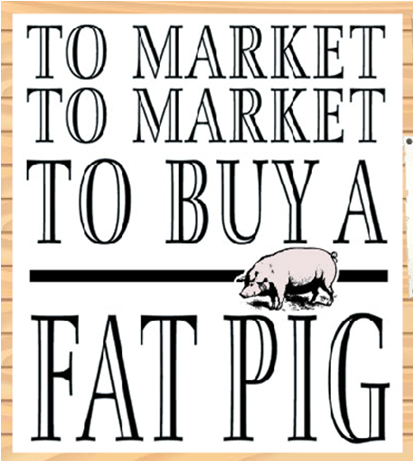
Home again, home again, dancing a jig;
To market, to market, to buy a fat hog;
Home again, home again, jiggety-jog;
To market, to market, to buy a plum bun,
Home again, home again, market is done.
So wrote Mother Goose, and generations have had this jingle stuck in their heads. So when Rick Sebak and his team from WQED-Pittsburgh decided to make a paean to public markets throughout the United States, they chose the opening line as both their title and a bit of a quest.
I watch a lot of films about the geography of food and teach many aspects of it in my classes. The films that show what is wrong -- drastically wrong, criminally wrong -- with our food systems are important and sometimes even enjoyable. This film is different and quite important, as it leads by example.
To Market To Market to Buy a Fat Pig is a pure celebration of that which is most right about food in the United States. (See Netflix listing -- available in streaming format.) The film explores farmers' markets in nine of these United States. The markets differ in all the ways that markets vary. Some are recent inventions while others have enjoyed a century of continuous operation. Some attract dozens of shoppers; others thousands. Some operate in fixed buildings every day of the week; others are set up in tents on city streets. Some are supplied only by local, organic farms; some include seafood; some include a lot of food pre-packaged or prepared on the premises.
In our own community, a small group of residents have worked over the past years to build and sustain Bridgewater Farmers Market. Results have been a robust mix of successes and difficult lessons, but the market seems close to a critical mass of both vendors and shoppers. As the film makes clear, no single model is appropriate to every community, and Bridgewater continues to work toward a model that will serve this community well.

I am proud to be playing a small part in the cultivation of a farmers' market in my own town, and equally proud that a young person who once studied coffee with me is now well-known as the manager of one of the most successful markets in the Boston area, the Union Square Farmers Market in Somerville.
Educators who wish to show this video to their classes may find my viewing companion (Word format) useful. Feel free to adapt to your own class, and please notify me if you do so.
Home Cookin'

Last Sunday, Wiley Miller's Non Sequitur comic shares a curmudgeonly view of cooking at home. Indeed, a lot of what is "cooked" in homes is merely heated up by legions of "box food people." I am happy to report, however, that a growing number of young people are interested in cooking.
This very morning, Pam's Spanish class is converging on our house to share dishes they created in relation to their study of Como Agua Para Chocolate (Like Water for Chocolate). Last week, students attending a Real Food Challenge event at BSU brought a fabulous assortment of dishes they created themselves.
When I asked students in my introductory environmental geography class how many of them (or their parents) grow at least some food at home, about 2/3 raised their hands, and many beamed as they listed the home produce. In the film To Market, To Market to Buy a Fat Pig, one of the market managers explains that his goal is to encourage home cooking.
Dining out is still enjoyable, of course, if it is actual dining. But as a friend who once worked in food service told us, the four major food groups in some restaurants are bags, boxes, bottles, and cans. We've found that all too often, eating out has meant paying much more for boring food than good food would have cost, with the only benefit having been that someone else did the dishes. And with a dishwasher in our kitchen, that is a mighty slim benefit!
So, we find ourselves in restaurants only when it is necessary in order to meet people or get other things done, or when we know that the chef can make something better than we can make it ourselves! We often find ways to avoid the former, and the latter becomes increasingly rare.
Tuesday, November 1, 2011
Here's the thing about Jerusalem Artichokes...
We just don't really like them. At the end of our CSA season we received a bag of this root vegetable, which had also been included in the early harvest. Our first attempt at making them palatable can be found here. Over the weekend I decided to try a recipe suggested on Colchester Farm's own blog and followed the instructions for the Cherokee Spiced Jerusalem Artichokes. I thought perhaps since the recipe calls for honey the sweetness might make them more to my liking. These need to marinated for several hours before serving, so I prepared them right after church on Sunday, and then James and I went to a play, and then did some shopping for a project my Spanish class is doing (stay tuned for links to recipes and other information about Like Water for Chocolate!) As we were finishing the shopping James mentioned how looking at all the good ethnic food had made him hungry. And I, without enthusiasm replied, "well, we have that jerusalem artichoke salad to look forward to when we get home." At which point he suggested we let it marinate another day, and that we order a pizza instead. So, finally, on Monday we served the 'chokes, along with some chicken breasts in mango sauce. "They aren't horrible," said I. "They're weird" answered James. This was the best we could say about them. I did finish my serving, but James, who took about 1/2 what I did, left some on his plate with a sarcastic remark about his eyes being bigger than his tummy. Later in the evening I was reminded of something we were told the first time we had them: that they were a "gassy vegetable." Right. Next season I think we will skip them.
Wednesday, October 26, 2011
Pho Fame

The event was organized by the Bridgewater One Book One Community committee as part of a series of events related to the reading of John Shor's Dragon House. Bridgewater Independent reporter/photographer Charlene McNeil beautifully captures the event, in which Anh Nguyen described her life in Vietnam, her flight just ahead of the fall of Saigon, and her life in the United States since 1975. As the photos reveal, the audience was mesmerized by the life of this delightful and unassuming woman.
Subscribe to:
Posts (Atom)