How It All Started

Bob Phillips

The title of this blog was inspired by one of my Spanish professor's at Miami University of Ohio, Dr. Robert Phillips, who died in the e...

Monday, October 15, 2012

Autumn Stew


We have no photo of the meal itself (beef stew is delicious but not photogenic). Instead, I staged the items that were on the table for our meal, as a reminder that centerpieces are not just for weddings! In fact, however, this lantern is repurposed from the wedding of a friend last year. We usually have a candle in it, but for the season we have filled it with miniature pumpkins from Hanson Farm  The tea lights are indeed resting on coffee beans.

Our plans for a stew on Sunday evening were delayed by an historic opportunity -- the last day of the premiere of Jack Kerouac's Beat Generation in his home town of Lowell. It was an enjoyable bit of time travel -- followed by a foliage-rich and sunny drive home along I-495 and the outer western suburbs of Boston.

It meant for a somewhat rushed (two hours instead of three or four) preparation of beef stew, based loosely on a recipe by Amy Sedaris. Yes, the twisted sister of David Sedaris has a cookbook -- more of a lifestyle book -- entitled I Like You: Hospitality Under the Influence, and its recipes are actually safe to use!

Page 254 features "What's Your Beef, Stew?" I started by not using a pound of sirloin steak tips from Northeast Family Farms in place of the cubed chuck. This grain-fed beef arrives marinaded in ginger and teriyaki, providing an exceptionally tender and flavorful base for the stew. I browned it in olive oil as I added  several table spoons of flour (less than Sedaris called for), skipping the shake-and-bake method she suggests as well. I sauteed an onions with the beef and then added water to simmer for an hour. (Sedaris calls for more and she is correct, but we did want to eat while we were still awake!)

Then I added potatoes, more onions, and carrots, and simmered for another 45 minutes. Actually, I failed to turn down the stove, so it was more of a continued boil (covered, thankfully) than a simmer. The result, however, was a rich, flavorful broth infused with ginger and the added pepper and paprika. Pam made delicious biscuits (see our chicken chowder post). Pam used a 50/50 mix of white and wheat flour, which was perfect!

Speaking of perfect, both the biscuits and the stew were very happily paired with our own baralo, a red wine that is maturing beautifully in our basement. The pairing was made even more perfect by the fact that I included about a half cup from the wine we had set aside on bottling day. Anytime we can cook with the beer or wine we are serving, we do so. We have never regretted it.

Friday, October 12, 2012

Fresh Counts


Because we believe fish and meat should be eaten sparingly, we prefer to eat them -- especially fish -- less often but of really good quality. And since we have figured out how to care for fish (basically, concentrating on not drying it out), we use simple recipes that allow the quality of the fish itself to dominate.

Today Pam found a simple tuna-steak recipe on the Old Bay web site. We have been checking lately because a friend of ours does promotional work for this venerable company whose product is the national spice of Maryland. (Massachusetts might be the "Bay State," but the real Bay is the Chesapeake, as we all know).

As we've mentioned before, "fresh fish" equals "drive to Mansfield" in our house, where Fresh Catch, Inc. never fails to live up to its name. I did a few errands in the area (such as getting a PFD for my new whaling hobby), making the fish catch last so I could bring it right home to refrigeration.

When dinner time came, we combined 1/4 cup olive oil with a generous dollop of Old Bay (true Marylanders do not need to measure such things), some parsley from our garden, and the juice of two limes. I marinaded a large, fresh swordfish steak in this mixture, after piercing it a few times so that the flavor would permeate.

Then Pam began to cook potatoes from our farm box, giving just enough time for the flavors to meld. The recipe calls for use of a grill, which would have been nice in better weather, but I used our indispensable cast-iron skillet with a little bit of chipotle olive oil from our favorite oil and vinegar emporium (in Maryland, natch).

Cooking it for about 10 minutes over high heat with this simple preparation allowed the fish itself to dominate -- as tender and flavorful as it was nutritious. As I let the fish rest, Pam had mashed the potatoes with regional butter and local milk, and then remembered to retrieve the local cranberries I had prepared with decidedly non-local whiskey last week.

We very much enjoyed the meal with our home-made Chardonnay. We have recently decided, by the way, that although we very much enjoy our red wine, we are going to leave whites to our local experts.

Saturday, October 6, 2012

Leek & Potato Soup

I took advantage of the leeks that came in our weekly farm box delivery to try a soup that I had been curious  about for a while. I turned to our mainstay for vegetarian cooking - Deborah Madison - for the recipe, which was so simple I felt the need to embellish it a bit. With just seven ingredients listed (in addition to water): leeks (white part only); potatoes; butter; salt and pepper & and milk. I replaced half of the water with vegetarian soup stock to give this a little more body. Madison actually uses the word "meager" in her own description. This was very easy to make. I cooked the chopped leeks and potatoes in butter for about 10 minutes in the soup pot, then added the liquid (2 cups of soup stock + 2 cups of water) and simmered for about half an hour. Then added some milk and heated again before serving. While I wouldn't exactly use the word meager, it did seem to be lacking in flavor. Next time I will use a higher proportion of soup stock, more milk, and add garlic and a few more herbs. I did learn something very important in preparing this meal: the instructions said to "set the leeks in a bowl of water to soak while you prepare the potatoes, then lift them out with a strainer, letting any sand fall to the bottom". Good thing I followed that. I had no idea. I would have been pretty disappointed if I'd ended up with gritty soup. James made some potato bread in our bread machine to go with this, which made the meal more hearty.

Milk is optional in this recipe, so it can easily be made vegan.

Tuesday, October 2, 2012

Cranberry "Recipe" Recipe

I was about to prepare a pound of fresh cranberries that I had picked up from Hanson Farm, but I could not find any rum in the cabinet. That's right: we usually use rum. What qualifies this as a new recipe is a substitution I used for one of our standards. I also changed the preparation methods a bit, to accommodate other things I was cooking for the same meal.

The original recipe -- in the first of our two big binders of recipes -- is as follows:


  • Place one pound of fresh cranberries in your indispensable cast-iron skillet, along with two cups of sugar (brown or white). Cover with foil or lid and place in a 250-degree oven for 1 hour.
  • Add 2-1/4 cups of rum and return to oven uncovered until evaporated.
  • Stir minimally, if at all.

Lacking rum, I opened a recently-purchased bottle of Seagram's 7. For sipping, we usually have something a bit more rarefied, like a Scotch or brandy, but we keep the Seagram's around for mixing or for less refined moods.

The whole category of distilled spirits is known as "recipe" in our house, after the moonshine kept for medicinal purposes by the Baldwin sisters on the Prohibition-era television show The Waltons.

What I actually did yesterday was:


  • Placed one pound of fresh cranberries in our indispensable cast-iron saucepan, along with one cup each of brown and white sugar. Covered with lid and placed in a 300-degree oven for 30 minutes.
  • Allowed to rest on stove top for about 45 minutes while the rest of the meal cooked at a higher temperature.
  • Added 2-1/4 cups of whiskey (see below) and cooked, uncovered, on stove top until it was evaporated, or nearly so.
  • Stirred almost not at all.
Had I to do this over again -- and I will! -- I would use a bit less whiskey, as the evaporation took far too long, and was not complete at serving time.

Returning in 2025 to update

This is now the only way I make cranberry sauce. I remembered that I have reduced the amount of whiskey I use, but I had not remembered that the original amount was so much. Really, a half cup or so will do. There is no point in letting THAT much evaporation happen with libations that could be enjoyed more directly. This also allows us to feel OK with using a fancier whiskey or aged rum.

Friday, September 28, 2012

Stirring Up Mocha Cake


This week's recetas nuevas are variations on two favorite recipes of long standing, made all the better with secret ingredients from our friends at L.O.V.E. -- the Lebherz Oil & Vinegar Emporium in Frederick, Maryland. As regular readers may know, this culinary treasure was recently established by a fellow alumna of UMBC, where Pam and I met a few years back. And don't worry: the "secret" ingredients are about to be revealed!

The first modification was a simple one. We were pleased to get some late-season eggplant, so of course made a bonus round of ratatouille (we thought we had put the season finale in the freezer a couple weeks ago). By adding a small hot pepper from our farm box and chipotle-infused olive oil from L.O.V.E. and cooking for four hours, this weapons-grade tomato stew was even more scrumptious than usual.


The genius part of the evening was the addition of dark chocolate balsamic vinegar -- along with a few other modifications -- to our favorite pound cake recipe. Our new creation is based on the Mocha-Swirl Pound Cake on page 191 of Mollie Katzen's classic Moosewood Cookbook (just try to find another two-word title with eight Os!). The result is a perfect use of Marley Coffee from Jamaica!

Our modified version requires
  • Butter (or Crisco or Pam) and flour for a Bundt pan
  • 1 pound (hence the name) of butter, softened. Yes, that is four sticks. I'm going rowing in the morning.
  • 2 cups unbleached, granulated sugar, preferably fair-trade organic, which is available from Costco, believe it or not!
  • 6 eggs, preferably from a local chicken. Ours were from Hanson Farm.
  • 4 cups white flour (use the healthy stuff on another recipe)
  • 1 Tbs. baking powder
  • 1/2 tsp. salt
  • 1 cup Buffalo Soldier Marley Coffee, strongly brewed. I used medium-roasted La Orchidea from my friend's farm in Nicaragua, because I did not have time to order the Marley Coffee, but I think the medium-dark Buffalo Soldier would be even better for this recipe! (Reserve the rest of the pot of coffee -- I used a Chemex -- to serve with the cake.)
  • 2 tsp. pure vanilla (also available from Costco, by the way)
  • 1/2 of a 3.5-ounce Ibarra Mexican chocolate disk, which lends just a hint of cinnamon  The next time I plan to use exotic pepper from Madécasse, which I happened to try the day after making this, and I think it would be even better. Melt the chocolate in microwave or on stove top.
  • 1 cup confectioner's sugar
  • 2-3 Tbs. dark chocolate balsamic vinegar (see above)
To prepare, first make the batter:
  • Beat together butter and sugar until fluffy. Beat eggs into mixture, two at a time.
  • Sift together flour, baking powder, and salt.
  • Alternate mixing dry ingredients and coffee into the butter mixture, until blended. Do not beat or over-mix.
Then prepare to swirl:
  • Separate one-third of the batter to a small bowl, blend in melted chocolate.
  • Prepare Bundt pan with butter and flour and pour in plain batter.
  • Dollop chocolate batter in clumps onto pan, and then use a knife to swirl gently into the plain batter. 
Bake and glaze:
  • Bake at 350 for 50-60 minutes, or less if using convection. Remove to wire rack to cool, and overturn gently onto a plate, using a spatula if necessary.
  • Meanwhile, sift confectioners sugar and whisk in 2 Tbs. chocolate vinegar. It will be difficult at first, but avoid the temptation to add too much liquid. Eventually, a thick glaze will form, which will drip off the whisk. Use this to drizzle glaze onto upright cake.
Present:
  • Use bread or cake knife to slice modest servings -- this is rich cake!
  • Garnish with espresso beans and/or mocha chips (ours were from Hilliard's)

Serve with Marley Coffee and try to contain yelps of true bliss, as the tart glaze melts perfectly into the rich mocha cake!

UPDATE: Having a professional photographer involved in the baking means a lot of cool shots of Stirring Up Mocha Cake in progress. Enjoy!

FURTHER UPDATE: We actually won this contest!


We were modifying a fairly complicated recipe, so all members
of the team had to study the original version!
Yes, a pound cake does have a full pound of butter.
But not in each slice!
It's all about Jamaica.
Jamaica, coffee, and chocolate, that is!
The chef hat does not help the coffee,
but hand grinding does!
While going to the trouble of baking
from scratch and using good Marley Coffee,
one might as well use a Chemex or
other pour-over brewing method.
Two hats are better than one for adding the coffee!
Coffee-infused batter!

And the cocoa batter

Swirl the two batters -- with and without cocoa.


Dark Chocolate Basalmic Vinegar glaze is the secrete ingredient.
The final presentation -- with espresso and mocha chips!

Thursday, September 13, 2012

A tale of two salads

The type food we get in our farm box haul varies quite a bit as the season moves along, and changes from year to year as well. We are still occasionally getting beets, and last week also received some peaches and pears, things we had not gotten in previous years. I did some searching on allrecipes.com to find out what I could build with these ingredients and found two delicious salads.

I made some changes to the, Roasted Beet, Peach, and Goat Cheese Salad, to incorporate ingredients we already had on hand, but was pleased to be able to use the beets and the peaches in one dish. I followed the instructions to roast the beets until I could easily remove the skin. I used more than the recipe called for as ours were rather small, ditto for the peaches, which I cut into small chunks. I added these to a mix of farm greens, lettuce, and herbs from my garden. I substituted a diced onion for the shallots, and included the feta and pistachios as suggested. Rather than make the vinaigrette recommended, I simply sprinkled some of our peach balsamic vinegar from the LOVE Emporium. It was a perfect use for it. A wonderful salad with ingredients I would not have thought to put together. And it tasted great paired with a Cabernet Sauvignon from the Milbrant vineyards of  the Columbia Valley of Eastern Washington.

The pears were well used in the Curried Cashew, Pear, and Grape Salad. After toasting the cashews I mixed them with the melted butter, curry powder, brown sugar, salt, and cayenne. I did not have fresh rosemary, so a used dry, which worked out fine. Again, I used a mix of greens and added the seasoned cashews, the cooked bacon, sliced pears and grapes. I tossed it all with the honey/mustard dressing included with the recipe. This was sweet, tangy, and salty, with a rich variety of textures.

Tuesday, September 4, 2012

Parm Perfection

Nueva Receta has been a bit quiet of late, as our late summer has had us enjoying some familiar recipes and more than our usual amount of dining out, during a lot of short family trips far from our recipe shelf. But now we are back in our culinary groove, and our attention returns to, yes, eggplant.

Over the weekend, we enjoyed a terrific end-of-summer party with friends who shared all kinds of local bounty. Our contribution included our raspberry whitbeer and the first bottle of our Barolo -- which turned out very well indeed, and is expected to get even better --  any my second batch of weapons-grade ratatouille of the year.

Because our daughter became very fond of eggplant Parmesan, my attention the next day turned to that vegetarian mainstay. I have seen her enjoy it at quite a few restaurants and though my previous attempts have been less than stellar, I decided to try again, with particular attention to texture. As regular readers of this blog will not be surprised to learn, I turned once again to kitchen goddess Deborah Madison, only slightly modifying her recipe on page 279 of Vegetarian Cooking for All.

I do not want to give the impression that cheese is always the route to bliss in Madison's pages, but it did once again contribute to the success of this dish.

I started with one large eggplant from Hanson Farm -- about as local as possible. It was fresher than anything from the grocery store would be, but it did take me a couple of days to get to this recipe. So where Madison writes that the slices (1/3-inch) should be salted for 30 to 60 minutes unless the eggplant is farm fresh, I decided to compromise. I very lightly salted the slices on both sides and left them out for 15 minutes while packing up the car for said daughter's return to school (this was to be a farewell dinner).

I then blotted them, remembering an overly salty try at this recipe last year, and brushed both sides with olive oil. I placed them under the broiler, first a bit close, then a bit far, then back close, until both sides were browned, almost charred. It is the nature of eggplant that they never got crisp (as they might if I had let the salting go longer), but I got them to a nice, caramelized state.

Meanwhile, I had mixed a small can of tomato paste with a 15-ounce can of tomato sauce, in lieu of the fresh tomato sauce that Madison calls for. As this heated, I stirred in slivers of basil cut directly from our garden. I then brushed a very small amount of oil into a baking pan, spooned in some of the sauce, and layered the semi-charred eggplant -- I had just one layer, but more would have been great. Over this I sprinkled shredded mozzarella (Madison recommends slices of fresh mozz if available) and spooned over the remaining sauce.

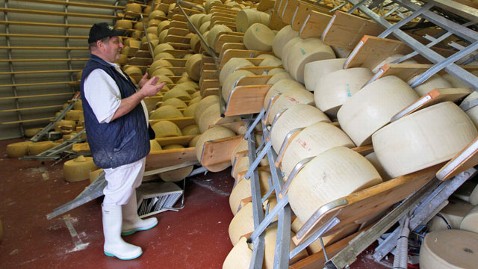
And then, of course, I sprinkled some cheese from our friends in Parma, grateful that the earthquake earlier this year did not get it all! I then baked for 25 minutes at 475 (convection), so that the sauce itself became sweet and sticky, along with the cheese. I had managed not to exceed the recipe's cheese parameters -- as I am often tempted to do -- but the meltiness made this dish just perfect for our daughter's sendoff.